7 Ways to Prevent Third-Party Data Harvesting in 2025



Updated on Apr 3, 2025
2024 saw some huge data breaches, and one of the biggest hit live event ticket vendor, Ticketmaster in May. Hackers breached its third-party cloud service provider, Snowflake, stealing 560 million of its customer records, including names, email addresses, phone numbers, and partial payment information. The hacking group ShinyHunters later put the data up for sale on dark web forums with the price tag of $500,000. It isn’t known whether the company paid up, but whether it did or not, its costs will likely still run into the millions given that regulatory fines, loss of business (caused by loss of reputation), and legal action brought by affected customers are all possible.
This attack may have prompted you to tighten your cybersecurity, but despite putting systems in place to keep your customers’ data safe, your business can still run into trouble because of ‘leaky’ third parties like Snowflake. Even though your company has robust data security policies and takes the utmost care to keep your users’ personal or sensitive data safe, you can’t always say the same for the third-party software vendors that your business relies on.
If the statistics are anything to go by, the chances are good that some of your trusted partners could be allowing unauthorized end-user data harvesting without your knowledge:
- 35.5% of all breaches in 2024 were due to third-party vendors (up 6.5% over the previous year), with healthcare and finance providers experiencing the highest numbers.
- 98% of organizations have links with a third-party software provider that has experienced a breach at some point.
Healthcare providers are thought to attract the most attention from cybercriminals because healthcare records fetch the most on the black market, they can’t be canceled like credit cards so they can be exploited for longer, and because the industry as a whole is a lucrative target with deep pockets. But in any industry, the bottom line is that the more third parties an organization’s web infrastructure connects with, the more likely it is to suffer a third-party attack.
Understanding Data Harvesting
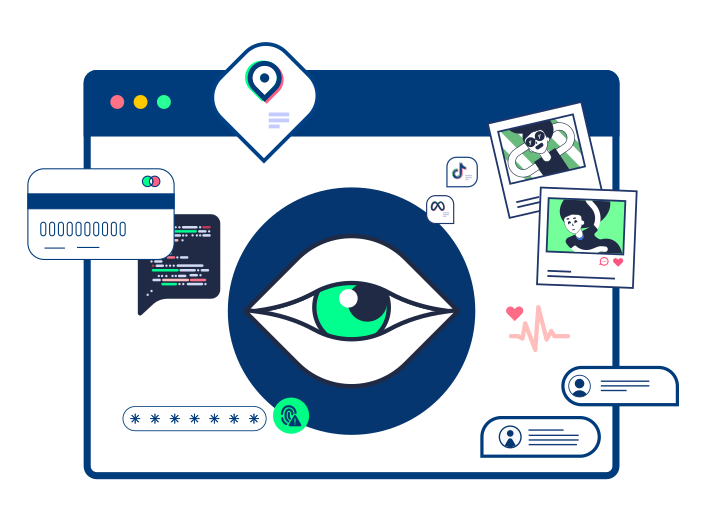
Data harvesting itself isn’t necessarily a bad thing. The term refers to the collection of large volumes of data from various online sources, and as long as the ‘harvester’ in question obtains permissions and complies with relevant laws and regulations, this is permissible. Problems arise when the harvested data includes personal information, details about users’ browsing habits, and other sensitive information that’s been gathered without their explicit consent. Companies use legitimately gathered data for purposes such as targeted advertising, but criminals illegally harvest health, financial, and private data because they can make money by selling or ransoming it.
The Ever-Growing Attack Surface
These days, most organizations with an online presence are at risk of illegal data harvesting, and this risk escalates when so many of them rely on third-party application vendors to supply and maintain the tools they need to function. It may be dangerous to trust sensitive data to external software, but it’s also essential because very few businesses have the resources and expertise to do everything themselves.
It makes sense for them to outsource sales, cloud storage, communications, customer relationship management, password management, advertising, and many more essential tasks to external providers because it’s the most cost-effective way to get the best tools. Third-party vendors are specialists in their respective areas, whether that’s website development, search engine optimization, or payment processing. They can provide scalable solutions, which can grow at the same pace as your business website, and they often provide customer support and maintenance services too.
So, the upside is clear, but with every new third-party software product that a company uses, the attack surface grows, and because each new provider may have privileged access to some of your customers’ sensitive data, the potential for a data breach increases. If your business uses dozens of such providers, then the scope for attack becomes enormous and the job of defending it becomes vastly more difficult too.
The Cost of Third-Party Data Harvesting
As we mentioned, data harvesting via illegal data breaches can harm a business in various ways, including:
Financial loss: A data breach caused by data harvesting can lead to significant financial losses including costs associated with investigating and resolving it, contesting lawsuits, and compensating those affected. It can also harm both your revenues and your customers’ confidence, because of the next point…
Reputational damage: Bad news travels fast, and businesses that have suffered from a cyberattack or data breach often struggle to attract customers or clients. Incidents like these can cause long-lasting reputation damage for companies because information on the internet can linger almost indefinitely. Just one breach can leave a company permanently tarnished.
Legal liability: In contrast with many other countries, the United States does not have a single comprehensive data protection law that governs the safety of personal data. However, it has enacted hundreds of federal and state laws, creating a complex web of regulations that aim to safeguard the personal information of American citizens. So, depending on its circumstances, a company may face prosecution over a data breach, which can lead to fines, lawsuits, and other legal penalties.
Operational disruption: A data breach can cause significant operational disruption for a company, including system downtime, security upgrades, and increased demands on IT resources.
Regulatory compliance issues: Most data breaches involve a breach of data protection regulations, which can be incredibly costly. For instance, in 2024, the top three GDPR fines in Europe were issued to LinkedIn, which paid €310 million, Uber at €290 million, and Meta with €251 million. Although the total for all fines paid was down on the previous year, this was only because 2023 featured Facebook owner Meta’s record $1.3 billion fine. The general trend is still one of big fines.
For an individual company found to have committed a serious data breach, the fines start at €20 million ($21.67 million). The numbers above are higher because GDPR fines can be levied at up to 4% of global revenue, and those big companies have high turnovers. Unfortunately, even if a third-party vendor is to blame for a data breach, the responsibility lies with you, the service provider, and don’t forget that if you also process customer credit card data, you could also be in breach of PCI-DSS regulations too, which might attract additional fines ranging from $5,000 to $100,000 for each month of non-compliance.
But what does a typical breach cost the average business? Well, every year, IBM Security reports on the worldwide average cost of a data breach, and for 2024 it was $4.88 million, a 10% increase from 2023 ($4.45 million), marking the largest annual spike since the pandemic.
Here’s how the typical costs of a global breach break down:
- Lost business – $1.47m
- Detection and escalation – $1.63m
- Post-breach response – $1.35m
- Notification – $0.43m
As bad as that looks, in the US, the average is $9.8 million, and mega breaches (involving 1-10 million records) though mercifully rare, are even more expensive. In 2024 they cost almost nine times as much as the average and started at around $42 million per breach.
Case Study: The TikTok Pixel Misconfiguration Incident
A notable example of unintended data harvesting involves a global travel marketplace that integrated TikTok’s tracking pixel into one of its regional websites. Due to a misconfiguration, the pixel collected and transmitted sensitive user data to TikTok’s servers without user consent, violating privacy regulations like the General Data Protection Regulation (GDPR). This incident underscores the importance of correctly implementing and regularly auditing third-party tools to prevent unauthorized data collection and ensure compliance with data protection laws.
Beyond Financial Loss: The Multifaceted Impact of Data Harvesting on Businesses
To summarize: when a company falls prey to unauthorized data harvesting, there are many consequences:
Reputational Damage: Unauthorized data collection can erode customer trust, and that means they’ll take their business elsewhere. Rebuilding the brand afterward can take a long time.
Regulatory Penalties: As we mentioned, non-compliance with data protection regulations can result in substantial fines and legal actions.
Operational Disruptions: Dealing with a data breach means you either need to divert your own resources to incident response, which could hinder your normal business operations, or pay to bring in external experts.
Competitive Disadvantage: if the data being harvested was proprietary or sensitive information (trade secrets) this could weaken the company’s market position and give your competitors an edge.
Steps to Preventing Third-Party Data Harvesting
1. Conduct Third-Party Vendor Audits
Since prevention is better than cure, assessing the cybersecurity risk of taking on any third-party vendor should begin before you give them access to your network and sensitive client data. You can weed out problematic vendors by making your audit requirements clear before you on-board them. Think of it as a vetting process. If they’re resistant to audits at this stage, then they are unlikely to be more forthcoming with the reassurances you need later on. You need to make sure that any third-party vendor commits to ongoing assessments of their data protection measures to keep both of you compliant with cybersecurity standards.
Your audits should seek evidence that a third-party vendor has a comprehensive information security program, but this is only the beginning. To truly safeguard your data, a vendor must be able to demonstrate their commitment to risk management through a robust vulnerability management program. They should be able to provide recent results from internal risk assessments, penetration testing, and compliance frameworks.
A critical aspect of risk management is having a solid supply chain risk mitigation strategy and plans for how to remediate any potential data breach. Ongoing third-party risk monitoring is crucial for gaining continuous insights into the vendor’s cybersecurity program. Conduct regular quarterly reviews to evaluate the vendor’s performance metrics and security posture.
Your organization’s reputation and customers’ trust depend on your ability to safeguard sensitive information. Therefore, it’s crucial to partner with third-party vendors that take risk management seriously and invest the resources needed to shut down potential threats. By prioritizing risk management and implementing regular third-party risk monitoring, you can help ensure that all the data under your control remains secure.
2. Adopt a Principle of Least Privilege (POLP) Model for Data Access
This is another element of prevention that also includes damage limitation if a breach occurs. The POLP approach means sharing information on a need-to-know basis. Just as you would only give your employees access to the minimum amount of information and system resources that they need to do their job (role-based access control), so you should also apply this principle to vendors to reduce the risk of third-party data harvesting. Even if a breach occurs, this approach limits the amount of sensitive data that would have been compromised if you had given a vendor access to everything.
3. Adopt the Zero-Trust Model
Zero-trust means that your systems will consider everyone using your network to be untrustworthy, so your systems will use ongoing authentication and authorization to ensure they maintain their access to applications and data. This approach uses techniques such as multi-factor authentication to prevent unauthorized access and ensures that if cyber criminals gain entry to one part of your system, they won’t be able to move laterally to compromise others.

4. Keep an Inventory of Your Vendors
Before you can adequately determine the risk level that your third-party vendors will introduce, you need to understand who they are and how much is being shared with each of them. If you don’t have an inventory of the third parties you are involved with, you won’t be able to assess the level of risk that they introduce.
Of those organizations that keep an inventory, some could improve their approach. Keeping different lists in different departments can be confusing, so set up a single central inventory and assign roles, conventions, and procedures for its maintenance. And once you have it, use it! Despite the dangers, less than half of organizations risk assess their vendors.
5. Continuously Monitor Your Third-Party Apps
Reflectiz continuous monitoring gives you an ongoing oversight of your online environment. It’s an entirely remote solution that requires no installation. It keeps track of all of your third-party applications (as well as open-source tools, iFrames, and external servers) and gathers information on them to create an online inventory that’s accessible via your dashboard in just minutes. It can spot all third- and fourth-party vulnerabilities, and flag up outdated software versions, and any compliance issues before they get costly. For instance, it detected problems with a client’s TikTok tracking pixel and saved them from the nightmare scenario of unauthorized data harvesting. Reflectiz security alerted the client right away and gave them steps to remediate the problem, which is quite something when you realize that in 2023, the discovery of a data breach took an average of 204 days.
With clear oversight of each application, you can quickly respond to any suspicious behaviors they might perform, and it’s a solution that doesn’t require you to write any code.
6. Include Cyber Risk in Your Vendor Contracts
It’s crucial to incorporate cyber risk into your vendor contracts to protect your company from potential third-party data breaches. By doing so, you can ensure that your vendors are accountable for any security breaches and take steps to maintain their security posture.
To better manage cybersecurity risks and hold your vendors accountable, you can also incorporate Service Level Agreements (SLAs) into your contracts. These agreements can help guide the cybersecurity behavior of your vendors and mitigate your company’s cybersecurity risk. You could require vendors to report and fix security issues within so many hours, depending on the severity of the problem.
Finally, to identify any potential security issues that external security scanning has missed, it’s recommended to include the right to request a completed security questionnaire from your vendors once per quarter. By following these best practices, you can ensure that your company is better protected.
7. Assess Fourth-Party Risks
Even your vendors often need to rely on other vendors, which means they could be sharing your clients’ data with them. Since you need to know about every such connection, make it a requirement in your contracts with them to divulge the fourth-party vendors they use, so you get a full overview of your attack surface. Reflectiz allows you to monitor fourth-party applications just as easily as third-party ones. It can alert you about changes to your website as soon as they occur and give you end-to-end tracking of your data, so you can avoid data harvesting before it happens.

Reflectiz Protects
Combining the seven suggestions we’ve listed will considerably improve your security posture, and with the Reflectiz platform, you can manage all your third-party software via one centralized dashboard. Contextualized reports enable you to learn about the behavior of all the external applications you use, including client interactions, data collection, and suspicious activities. Book a demo today to see how you can keep using the third-party apps your online business needs without compromising your website security.
FAQs
How does continuous monitoring of third-party apps help prevent data harvesting?
Continuous monitoring provides real-time visibility into the behavior of all third-party applications running on your website, including open-source tools, iFrames, and external servers, without requiring any code installation. This approach enables security teams to detect suspicious behaviors, outdated software versions, data compliance issues, and unauthorized data collection as they happen, rather than after the fact. For example, continuous monitoring platforms can detect TikTok pixel misconfigurations that collect and transmit sensitive user data without consent, alerting the team immediately with remediation steps. This is critical given that in 2023, the average time to discover a data breach was 204 days. Continuous monitoring eliminates that gap and provides organizations with an always-on, code-free overview of their entire third-party ecosystem.
How should businesses conduct third-party vendor audits to prevent data harvesting?
Businesses should vet third-party vendors thoroughly before granting them access to sensitive data. The audit process should start before onboarding and continue on a regular basis. Key steps include: requiring vendors to demonstrate a comprehensive information security program, reviewing results from internal risk assessments and penetration tests, verifying compliance frameworks, and ensuring they have a solid supply chain risk mitigation strategy. Contracts should include Service Level Agreements (SLAs) for cybersecurity behavior, such as requiring vendors to report and resolve security issues within defined timeframes. A quarterly security questionnaire helps identify issues that automated scanning may miss. Ongoing third-party risk monitoring, ideally via a continuous monitoring platform, provides real-time visibility into vendor security posture and helps ensure compliance with data protection regulations.
How should organizations protect web tracking data from security breaches?
Even lawfully collected web tracking data creates serious risks if stored without proper safeguards. Poor practices like unencrypted databases, weak access controls, or outdated software make user data vulnerable to cybercriminals. Under GDPR, organizations must implement appropriate technical and organizational measures to protect personal data. Key security practices include: applying strong encryption for data at rest and in transit (industry standards like AES-256 and TLS 1.3 are recommended), regularly and securely deleting data no longer needed, enforcing role-based access controls (RBAC) and monitoring usage logs, conducting regular penetration testing and security audits, and requiring all vendors and partners to comply with recognized security frameworks like ISO 27001 or SOC 2.
What are the main financial costs of a third-party data breach?
A third-party data breach carries substantial financial consequences. According to IBM Security’s 2024 report, the global average cost of a data breach reached $4.88 million — a 10% increase from 2023. In the US, the average rises to $9.8 million. These costs break down into four main areas: lost business ($1.47M), detection and escalation ($1.63M), post-breach response ($1.35M), and notification ($0.43M). For mega breaches involving 1–10 million records, costs can start at $42 million. On top of direct costs, companies may face GDPR fines of up to 4% of global annual revenue (a minimum of €20 million for serious violations), PCI-DSS penalties of $5,000–$100,000 per month, lawsuits from affected customers, and long-term revenue loss from reputational damage.
What are the main legal risks of web tracking without user consent?
Tracking users without consent violates major privacy regulations. In the EU, collecting non-essential data via cookies without prior consent breaches the ePrivacy Directive and GDPR. In California, the CCPA/CPRA requires businesses to provide clear notice and an easy opt-out mechanism for data sale or sharing. Violations can result in significant fines, reputational damage, and loss of user trust. Best practices include deploying clear cookie banners with equal Accept/Reject options, using granular consent, storing proof of consent, and regularly auditing consent mechanisms.
What are the risks of sharing web tracking data with third-party vendors?
Sharing user data with third-party vendors such as advertisers, analytics providers, and cloud platforms without proper vetting is a major privacy compliance risk. Under GDPR, controllers must have Data Processing Agreements (DPAs) with processors and ensure they provide sufficient privacy and security guarantees. Without these agreements, organizations risk exposing user data to unknown or untrustworthy entities. Best practices for managing third-party data sharing include: maintaining a vendor register documenting who has access to user data and why, conducting due diligence on all third-party providers before onboarding, signing Data Processing Agreements (DPAs) as legal contracts outlining vendor data protection responsibilities, using data flow diagrams to visualize and monitor where data travels, and blocking unauthorized data transfers to unknown domains.
What does data minimization mean in web tracking?
Data minimization is a key principle in modern privacy law requiring organizations to collect only the data strictly necessary for a stated purpose. In web tracking, this means avoiding collection of full browsing histories, GPS locations, or unrelated personal identifiers unless essential. Excessive data collection increases compliance risks and breach severity. To apply data minimization: audit all data collection points to ensure only necessary data is gathered, map data collection flows and justify each data point against business needs, regularly review and delete unnecessary data, involve your privacy or compliance team when designing new tracking mechanisms, and use monitoring tools to ensure tracking technologies stay within defined parameters.
What is cross-site tracking and why is it risky?
Cross-site tracking involves following users across multiple websites to build detailed behavioral profiles using third-party cookies or browser fingerprinting. Browser fingerprinting combines device and browser settings to create a unique user identifier. Under EU law, this generally requires explicit consent under the ePrivacy Directive, and GDPR governs the downstream use of that data. The risks include manipulative advertising, discriminatory pricing, and privacy violations. To mitigate risks: maintain a public list of all third-party trackers, disclose cross-site tracking practices in your privacy policy, implement consent management platforms, and explore privacy-friendly alternatives like server-side analytics.
What is Global Privacy Control (GPC) and how does it affect web tracking?
Global Privacy Control (GPC) is a browser-based signal that communicates a user’s opt-out preference for the sale or sharing of their personal data. Under California’s CCPA/CPRA, businesses are legally required to honor GPC signals. The older Do Not Track (DNT) signal never became a binding standard, but GPC has been confirmed as legally enforceable by California regulators. In the EU, the model is consent-based: non-essential cookies require opt-in before being set, and GDPR also grants a right to object to certain processing like direct marketing. Ignoring opt-out signals or making the opt-out process harder than opting in (known as “dark patterns”) violates user rights and regulations. To comply: implement mechanisms to respect GPC and browser-level opt-out signals, make the opt-out process as easy as opting in, regularly test systems to ensure opt-out requests are properly enforced, and confirm to users when their opt-out has been registered.
What is the Principle of Least Privilege (POLP) and how does it reduce data breach risk?
The Principle of Least Privilege (POLP) means granting users, employees, and third-party vendors access only to the minimum data and system resources required for their specific role or function. Applied to third-party vendors, this approach limits exposure by ensuring that if a vendor is compromised, attackers only gain access to a restricted portion of your data rather than your entire system. POLP works similarly to role-based access control (RBAC) for employees. Even if a data breach occurs, limiting vendor access dramatically reduces the volume of sensitive data that can be stolen. This dual benefit — prevention and damage limitation — makes POLP one of the most effective safeguards against unauthorized third-party data harvesting.
What is the Zero-Trust security model and how does it protect against data harvesting?
The Zero-Trust security model operates on the principle that no user, device, or system, whether inside or outside your network, should be automatically trusted. Instead, every access request must be continuously verified through ongoing authentication and authorization mechanisms such as multi-factor authentication (MFA). This prevents cybercriminals from moving laterally across your systems if they breach one component. Applied to third-party vendor relationships, Zero-Trust ensures that even if a vendor’s credentials are compromised, attackers cannot freely traverse your network or access sensitive data. By requiring verification at every access point and limiting trust by default, Zero-Trust significantly reduces the attack surface for unauthorized data harvesting.
What is third-party data harvesting and why is it dangerous?
Third-party data harvesting refers to the collection of user data by external vendors or software providers that a business integrates into its systems. It becomes dangerous when that data, which may include personal information, browsing habits, financial details, or health records, is collected without users’ explicit consent. In 2024, 35.5% of all data breaches were attributed to third-party vendors, affecting industries like healthcare and finance the most. The risks include regulatory fines under laws like GDPR (starting at €20 million), reputational damage, legal liability, and significant financial losses. IBM Security reported the average cost of a data breach in 2024 was $4.88 million, with US breaches averaging $9.8 million.
What is web tracking?
Web tracking refers to the practice of collecting, analyzing, and storing information about a user’s interactions with websites, applications, or online services. It typically involves gathering data like browsing behavior, device identifiers, IP addresses, and consent. Web tracking is used for legitimate purposes including website functionality (session cookies), security and fraud prevention, analytics, personalization, privacy compliance, and consent-based advertising.
Why is tracking sensitive categories of data particularly risky?
Sensitive category data includes health conditions, financial status, sexual orientation, religious beliefs, and political affiliation. Tracking data in these categories is considered especially intrusive and is explicitly restricted under GDPR, which requires explicit consent and strong justifications for processing such “special category data.” The risks are severe: misuse can lead to discriminatory profiling, denial of services, or targeted exploitation. For example, health tracking without consent could allow advertisers to infer medical conditions for manipulative targeting. To handle sensitive data responsibly: avoid collecting it unless absolutely necessary, require explicit informed consent and document it when essential, apply strong anonymization or pseudonymization techniques, and restrict access to sensitive datasets to the minimum number of authorized staff. In most cases, tracking sensitive categories for marketing or analytics purposes is neither ethical nor lawful.
Why should businesses maintain a centralized inventory of their third-party vendors?
A centralized vendor inventory is essential because you cannot assess, manage, or protect against risks you are not aware of. Without knowing which third parties have access to your systems and what data is shared with each, it is impossible to accurately measure your attack surface. Many organizations maintain separate lists in different departments, which creates confusion and security gaps. A single, centralized inventory with clear roles, naming conventions, and maintenance procedures enables effective risk assessment and ensures nothing falls through the cracks. Despite the clear importance of this practice, fewer than half of organizations actually risk-assess their vendors — making a complete and actively maintained inventory a key differentiator in data breach prevention.
Subscribe to our newsletter
Stay updated with the latest news, articles, and insights from Reflectiz.
Related Articles


AI Has Changed The Web.
Are You Ready for What’s Next?
Third-party code shifts by the hour. Supply-chain compromises strike without warning. AI-driven web attacks now evolve faster than traditional security can ever keep up.
Reflectiz delivers the continuous, real-time visibility needed to expose the risks traditional tools miss entirely.
Zero code changes. Zero access to your data. Ultimate peace of mind.