Protect Your Web From Unlawful Data Collection by Pixels and Cookies
Close the Gap Between Privacy Policy and Real-World Practice

Unauthorized Access and Compliance Gaps Drive Privacy Risks
Unauthorized access to sensitive data through third-party trackers, pixels, and cookies remains the top global privacy concern, while compliance gaps between privacy policies and actual data practices erode consumer trust and create regulatory exposure. With dynamic tracking technologies that often misalign with stated privacy policies, organizations face mounting pressure from stricter regulations and must implement comprehensive data protection strategies to avoid hefty fines, reputational damage, and class action lawsuits.
Reflectiz Privacy Dashboard
Third Parties Can’t Hide
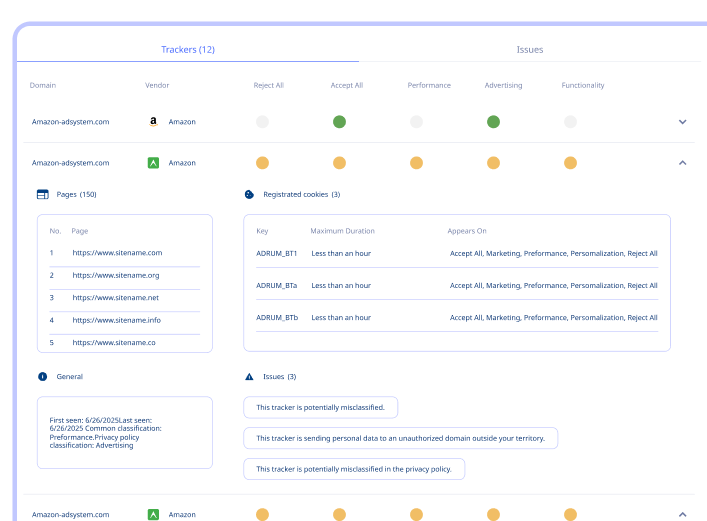
Our comprehensive monitoring discovers all trackers and scripts, understands their behaviors, and tracks where personal data is sent (including across borders). We catch unauthorized marketing or analytics tools operating outside oversight before they become risks.


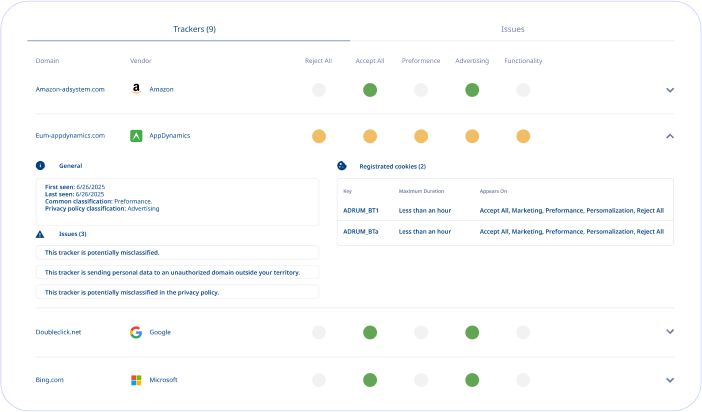
Flags When Your Policy and Practice Don't Line Up
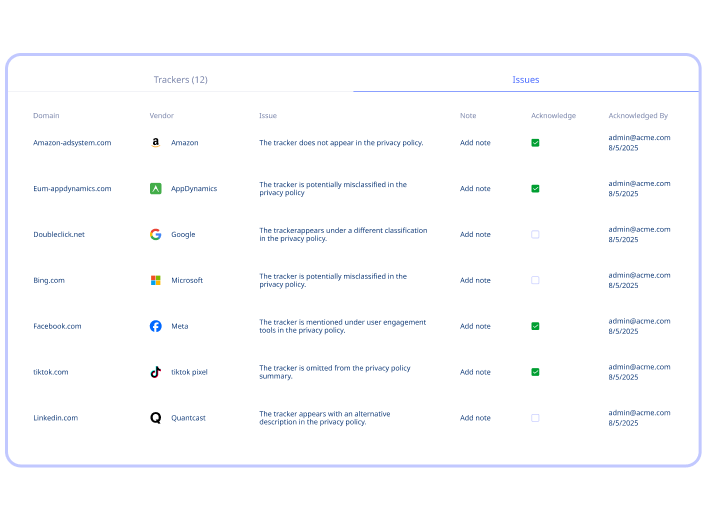
The Dashboard highlights deviations between your privacy policy and actual code behavior, enabling easy comparison against GDPR, CPRA, and CCPA standards.
Get a comprehensive map of all active components sorted by specific sensitive actions:



Reduces Regulatory Risk & Saves Time
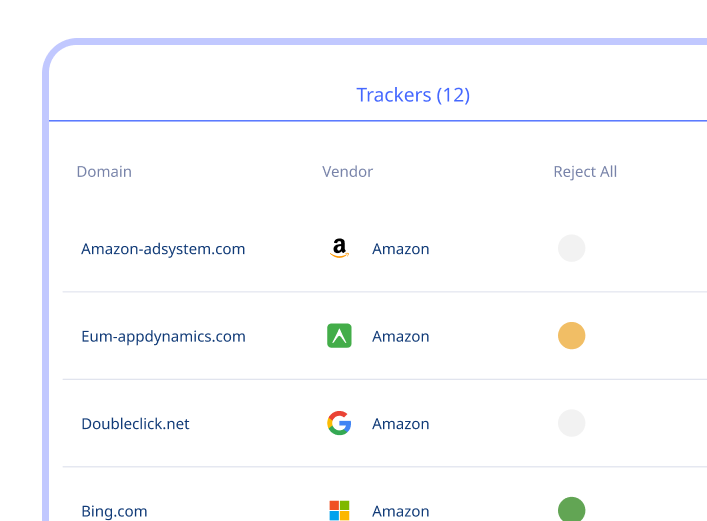


Our system automatically detects policy violations from unauthorized trackers and misaligned data flows, flagging site updates, vendor changes, and emerging risks. Continuous monitoring picks up remotely executed changes, even when code is controlled by others.





“Reflectiz gives us the visibility we lacked. If a Facebook pixel suddenly starts doing something different, we know. That kind of behaviour protection is what really sets it apart from the other tools we evaluated”

Gain Unparallelled Visibility and Own Your Web Privacy Today
Book Your Personalized Demo

FAQs
How does Reflectiz detect unauthorized third-party trackers and pixels on websites?
Reflectiz detects unauthorized third-party trackers and pixels using agentless, remote monitoring that continuously scans all active scripts and code components on your website. Unlike traditional security tools, Reflectiz does not require installation of a code agent — it monitors externally, analyzing all third-party behaviors including actions within iFrames, window location manipulation, and cookie activity. The system builds a comprehensive inventory of every tracker, pixel, and analytics tool present on the site, understands what data each one accesses, and flags any operating outside privacy oversight or without explicit authorization. When a tracker like a Facebook pixel suddenly changes its behavior, Reflectiz alerts security teams immediately, providing behavior protection that static scanning tools cannot offer.
How does Reflectiz handle remotely executed third-party code changes that affect privacy compliance?
Remotely executed third-party code changes are one of the most challenging privacy compliance risks because organizations have no direct control over when or how vendor scripts update their behavior. Reflectiz addresses this by automatically and continuously monitoring all third-party web apps and open source tools in production — even those whose code is controlled entirely by external vendors. When a script changes remotely — such as a tag management system updating its behavior, or an analytics provider modifying what data it collects — Reflectiz detects the change instantly and alerts security and privacy teams. This eliminates the compliance blind spot created by vendor updates that happen outside the organization’s change management process, ensuring that unexpected modifications to third-party behavior do not create undetected GDPR, CCPA, or CPRA violations.
How does Reflectiz help organizations achieve website privacy compliance?
Reflectiz helps organizations achieve website privacy compliance through continuous, agentless monitoring of all third-party scripts, pixels, cookies, and trackers active on their websites. The Reflectiz Privacy Dashboard automatically detects policy violations from unauthorized data collectors, flags deviations between stated privacy policies and actual data behaviors, and maps exactly where personal data travels — including cross-border transfers. It uses Natural Language Processing (NLP) to extract key commitments from your public privacy policy and compares them against live code behavior in real time. This enables security and privacy teams to quickly identify compliance gaps against GDPR, CPRA, and CCPA standards without needing to install any code on the website.
How does Reflectiz monitor cross-border personal data transfers for privacy compliance?
Reflectiz monitors cross-border personal data transfers by continuously tracking where data collected on your website is sent — including which third-party servers, in which countries, receive that data. This is a critical requirement under GDPR, which restricts data transfers outside the EU to countries with adequate protection levels. Reflectiz’s comprehensive monitoring discovers all trackers and scripts, understands their behaviors, and maps exactly where personal data flows, including cross-border destinations. When a marketing pixel or analytics tool begins sending data to a previously undisclosed jurisdiction, Reflectiz detects and flags this immediately. This gives privacy and compliance teams the visibility they need to ensure that all cross-border data transfers are authorized, documented, and compliant with applicable transfer mechanisms such as Standard Contractual Clauses.
How does Reflectiz use NLP to enforce privacy policy compliance on websites?
Reflectiz uses Natural Language Processing (NLP) to automatically parse and extract specific data privacy commitments from an organization’s public-facing privacy policy. The system identifies key statements about what data is collected, which vendors receive it, and how it is used. These extracted commitments are then used as a compliance baseline against which Reflectiz continuously compares live website behavior. When the actual behavior of third-party scripts, pixels, or cookies deviates from the policy commitments — such as sending data to an undisclosed vendor or collecting additional data types — Reflectiz flags the violation automatically. This NLP-driven approach eliminates the need for manual policy review cycles and enables near-real-time enforcement of privacy policy commitments across all website environments.
What actions within iFrames does Reflectiz detect for website privacy compliance?
Reflectiz detects privacy-relevant actions within iFrames as part of its comprehensive website monitoring capabilities. iFrames are commonly used to embed third-party content such as ads, payment forms, and social widgets, and they can execute JavaScript that is invisible to standard website monitoring tools. Reflectiz specifically monitors iFrame activity for unauthorized data collection, form input interception, cookie manipulation, and user behavior tracking that occurs within the embedded frame context. This is particularly important for detecting when third-party iFrame content changes its behavior remotely — for example, when an ad network embedded via an iFrame starts collecting personal data beyond its original scope. By tracking iFrame actions, Reflectiz provides visibility into data flows that would otherwise be hidden from privacy and security teams.
What is the gap between a privacy policy and actual data practices, and how does Reflectiz close it?
The gap between a privacy policy and actual data practices occurs when a website’s stated data collection commitments — what its privacy policy says it does — diverge from what third-party scripts and trackers actually do in production. This is a top compliance risk, as dynamic tracking technologies frequently change their behavior after deployment. Reflectiz closes this gap by using Natural Language Processing (NLP) to extract specific privacy commitments from your public privacy policy, then continuously monitoring live website behavior to detect any deviations. When a tracker begins collecting data types not covered by the policy, or sends data to undisclosed destinations, Reflectiz flags the discrepancy in real time, enabling compliance teams to act before regulators or users notice the violation.
What is website privacy compliance and why does it matter?
Website privacy compliance means ensuring your website collects, processes, and stores personal data in accordance with applicable privacy regulations such as GDPR, CCPA, and CPRA. It matters because non-compliance exposes organizations to significant regulatory fines, class action lawsuits, and reputational damage. Studies show that 75% of the most visited websites in the US and Europe are not privacy compliant, and only 45% of websites honor user opt-out requests. Compliance requires more than publishing a privacy policy — it demands continuous monitoring of all trackers, pixels, and cookies to verify that actual data practices align with stated policies and legal requirements.
What privacy regulations does the Reflectiz compliance solution support?
The Reflectiz privacy compliance solution supports the three major data protection regulations: GDPR (General Data Protection Regulation) in Europe, CCPA (California Consumer Privacy Act), and CPRA (California Privacy Rights Act) in the United States. The platform’s Privacy Dashboard maps all active data-collecting components against the specific requirements of each standard, enabling organizations to quickly identify which trackers, cookies, or data flows violate specific regulatory requirements. By automatically comparing live website behavior against these frameworks, Reflectiz enables compliance teams to prioritize remediation efforts and maintain audit-ready documentation across all regulatory jurisdictions their business operates in.
What risks do third-party cookies and pixels pose to website privacy compliance?
Third-party cookies and pixels pose significant privacy compliance risks because they collect and transmit user personal data, often without the user’s explicit knowledge or consent. Key risks include unauthorized data collection by marketing and analytics tools outside their declared scope, cross-border data transfers to undisclosed servers, compromised cookies that become vulnerable to exploitation, and actions within iFrames that track users invisibly. According to Reflectiz data, 53% of risk exposures in Retail stem from excessive use of tracking tools, and only 45% of websites actually honor users’ opt-out preferences. If a pixel or cookie behaves unexpectedly — such as a Facebook pixel suddenly collecting additional data fields — organizations can face GDPR, CCPA, or CPRA enforcement actions, class action lawsuits, and reputational damage.