Secure Your Website Against Magecart Web Skimming Attacks
Identify and prevent web skimming attacks to significantly reduce the risk of a costly data breach

The Damage Is Much Greater Than a Single Fine
Magecart attacks typically involve injecting malicious code into the checkout pages of vulnerable e-commerce websites in order to steal credit card information and other sensitive data.
While these types of attacks can indeed lead to data breaches that might result in hefty GDPR/CCPA fines, this is not the only consequence. Class-action lawsuits, brand damage, and the loss of clients’ trust can create devastating financial implications for your business.
*Source: https://geminiadvisory.io/gemini-annual-report-2021-magecart-thrives-in-the-payment-card-fraud-landscape/

Detect and Block Magecart Threats
Get complete coverage against Magecart malware attacks with advanced continuous monitoring that detects and prevents any malicious change to your websites so you never miss even the most sophisticated of attacks.


Ensure continuous monitoring of all sensitive web pages:



Stay Vigilant Against Any Malicious Change
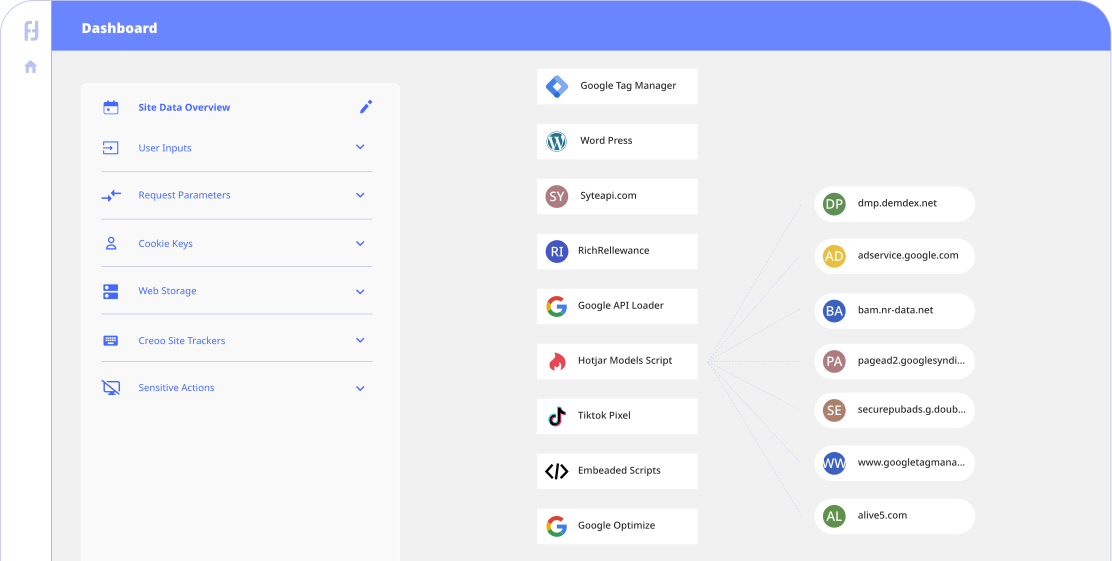
With Reflectiz, you can:

Here is what our clients had to say about us



Businesses can enjoy peace of mind
knowing their websites are safeguarded from Magecart attacks through Reflectiz’s continuous monitoring solution:


Security Insights




AI Has Changed The Web.
Are You Ready for What’s Next?
Third-party code shifts by the hour. Supply-chain compromises strike without warning. AI-driven web attacks now evolve faster than traditional security can ever keep up.
Reflectiz delivers the continuous, real-time visibility needed to expose the risks traditional tools miss entirely.
Zero code changes. Zero access to your data. Ultimate peace of mind.

FAQs
Can Magecart attacks be blocked in real time, or only detected after the fact?
Modern client-side security platforms including Reflectiz offer both detection and active blocking capabilities. Once a malicious behavior is identified — such as a script attempting to read payment field contents or make calls to an unrecognized external domain — the platform can trigger an immediate block on demand, preventing data from leaving the browser. Detection alone is valuable for investigation and compliance, but real-time blocking is what eliminates the risk of data exfiltration entirely.
How do Magecart attackers gain access to a website?
Attackers typically exploit one of three entry points. First, they may target vulnerabilities in the website’s own code or content management system, such as unpatched plugins, outdated frameworks, or misconfigured admin panels. Second, they compromise trusted third-party vendors — analytics tools, chat widgets, tag managers, or advertising scripts — that the merchant has already embedded on their pages; once a vendor’s script is tainted, every site using it becomes a victim. Third, supply-chain hijacking through CDNs or open-source repositories can deliver malicious payloads without any visible change to the merchant’s own codebase. In all cases the goal is the same: establish a silent execution path inside the user’s browser.
How does PCI DSS v4.0.1 address Magecart and web skimming?
PCI DSS version 4.0.1, which became mandatory in April 2025, introduces explicit requirements for client-side security that directly address web skimming. Merchants and service providers must maintain an inventory of all scripts running on payment pages, justify the purpose of each script, ensure scripts are not tampered with, monitor for unauthorized access to cardholder data input fields, and detect and respond to attacks against those fields. These requirements apply to all scripts — first-party and third-party — and are designed to close the gap that Magecart-style attacks exploit.
How does Reflectiz detect Magecart threats that bypass traditional defenses?
Reflectiz uses runtime behavioral analysis rather than signature-based detection. It observes which scripts access sensitive DOM elements such as payment and login fields, tracks where captured data is transmitted, and flags unauthorized network calls — regardless of whether the malicious code is obfuscated or not. Because Reflectiz monitors behavior rather than code signatures, it can detect novel or heavily obfuscated skimmers that antivirus or WAF rules would miss. It also continuously inventories all first- and third-party scripts, alerting security teams to newly introduced resources or behavioral changes in existing ones.
Is Magecart only a risk for large enterprises, or can small e-commerce sites also be targeted?
Magecart attackers make no distinction based on company size. While high-profile breaches at major retailers and ticket platforms attract media attention, the majority of Magecart victims are small and mid-sized merchants. Attackers frequently target smaller sites precisely because they tend to have fewer security resources and longer detection windows. Automated scanning tools allow criminal groups to identify and compromise thousands of vulnerable sites simultaneously, making any unprotected checkout page a viable target regardless of the merchant’s revenue or brand recognition.
What are the business consequences of a Magecart attack beyond regulatory fines?
While GDPR and CCPA fines can be substantial, they are only part of the financial exposure. Organizations that suffer a Magecart breach also face class-action lawsuits from affected customers, mandatory forensic investigations, card-scheme fines and chargebacks from payment networks, significant costs to notify affected individuals, and lasting reputational damage that depresses customer trust and conversion rates long after the incident is resolved. The combination of these factors frequently results in total losses that far exceed the regulatory penalty alone.
What is a Magecart web skimming attack?
A Magecart web skimming attack is a type of cyberattack in which criminals inject malicious JavaScript code into the checkout pages of e-commerce websites to silently steal sensitive data — primarily payment card numbers, CVV codes, expiration dates, and personally identifiable information (PII). The term originated as a portmanteau of “Magento” and “shopping cart,” reflecting its early focus on the Magento platform, but it now describes any client-side digital skimming technique regardless of the underlying e-commerce stack. When a shopper enters their payment details, the injected skimmer captures the data in real time and forwards it to an attacker-controlled server — often before the form is even submitted.
What pages should be prioritized for Magecart protection?
Checkout and payment pages are the highest-priority targets because they capture financial data. However, a robust protection strategy must also cover login pages (to prevent credential theft), account registration forms (PII collection), and any page that loads third-party scripts with access to sensitive input fields. Reflectiz monitors the entire user journey — from landing page to order confirmation — to ensure no stage is left unprotected. PCI DSS v4.0.1 now explicitly requires merchants to maintain a script inventory and monitor behavior across all payment-handling pages.
What types of sensitive data do web skimmers steal?
Web skimmers are designed to intercept anything a user types into a web form. Targets include full payment card numbers and CVV codes, card expiration dates, billing names and addresses, email addresses and login credentials, phone numbers, and any other PII submitted during checkout or account registration. More sophisticated campaigns also harvest session tokens, enabling attackers to take over existing accounts even without the password.
Why are Magecart attacks so difficult to detect with standard security tools?
Standard security controls — Web Application Firewalls (WAFs), vulnerability scanners, and secure development pipelines — operate at the server or network perimeter. Magecart attacks run entirely inside the end user’s browser after the legitimate page has been served. From the server’s perspective, nothing looks wrong: the page loads correctly, SSL certificates are valid, and no backend anomalies are triggered. The malicious JavaScript executes silently, harvests data before it leaves the client, and exfiltrates it to attacker-controlled domains. According to Gemini Advisory, the average dwell time for a Magecart attack is 171 days — well over five months during which shoppers’ data is continuously stolen.