Take Control Over a Complex Tag Environment
Seamlessly scale your web environment with complete tag visibility and control.

Digital Transformation and Security Operations go Head to Head
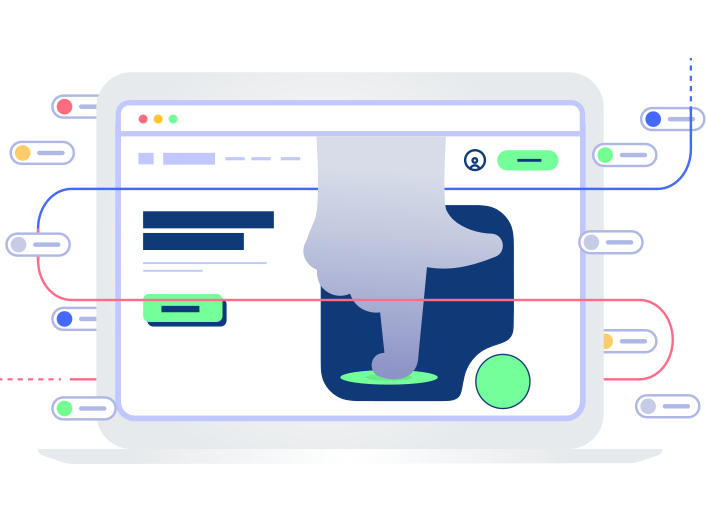
While tag managers enable marketers and digital teams to easily add tags and integrations directly into the website’s production environment, these may also bypass standard security protocols. Marketing teams want freedom to innovate, but security is focused on risk management. This creates an internal conflict of interest where both parties are correct.
Don’t let Security Become a Hurdle to Innovation
Get notified about any new tag or changes made to your website environment, even if it was added through an approved tag manager.
From now on, marketing and security teams can work together harmoniously by providing a solution that enables secure and supervised tag implementation.


Case Study: Unmanaged GTM Tags Become a Security Nightmare
Explore how a global ticket seller experienced a data breach due to a misconfigured GTM tag, highlighting the critical need for clear ownership and proper management of GTM tags.
A tag sneaking in unnoticed? Not on our watch


Detect any changes to scripts, applications, pixels or tags and automatically map it into your asset inventory


Receive a comprehensive analysis and overview of your third- and fourth-party application relationships


Get the full risk profile on any app added by any of your tag managers
Quickly spot all website tags and fix any security and privacy gaps!
FAQs
How can marketing and security teams collaborate safely using tag managers?
Marketing and security teams can collaborate safely using tag managers by implementing a monitoring solution that gives security full visibility into all tag activity without blocking marketing’s ability to move quickly. Reflectiz enables this by notifying the security team about any new tag or change made to the website environment — even through an approved tag manager — while still allowing marketing to operate self-sufficiently. This resolves the fundamental conflict of interest between the two teams: marketing wants freedom to innovate and deploy tracking tools, while security needs to manage risk and maintain oversight. With Reflectiz, security can review the risk profile of any new tag after deployment, flag potential issues, and work with marketing to remediate them, rather than creating bottlenecks through pre-approval gates.
How did a misconfigured GTM tag cause a data breach in a global ticket seller?
A global ticket seller suffered a data breach caused by a misconfigured Google Tag Manager (GTM) tag, illustrating the critical security risks created by unmanaged tag environments. In this case, a GTM tag was improperly configured, creating an opening that allowed unauthorized data access or exfiltration from website users. The root cause was clear ownership failures: no single team was responsible for auditing what tags existed in GTM, who had added them, and whether they were functioning as intended. This is a common problem in large organizations where marketing teams have GTM access but security teams lack visibility into the tag environment. Reflectiz documented this incident in a case study to highlight the need for comprehensive tag management security that bridges the gap between marketing agility and security governance.
How do tag managers bypass standard security protocols?
Tag managers bypass standard security protocols because they are designed to give non-technical teams — primarily marketing — the ability to deploy JavaScript code directly into production websites without requiring engineering involvement or code review. This means tags can be added without going through the organization’s change management process, security reviews, or vulnerability scanning pipeline. In a typical enterprise, security controls include code review, testing, and approval workflows before any code reaches production. Tag managers circumvent all of these by providing a self-service interface that deploys code directly. Additionally, many tags load other third-party scripts (fourth-party dependencies) that are entirely outside the organization’s visibility, further expanding the attack surface without any security oversight.
How does Reflectiz detect changes made through Google Tag Manager in real time?
Reflectiz detects changes made through Google Tag Manager in real time using continuous, agentless external monitoring that does not require any code to be installed on the website. The platform continuously scans all scripts, tags, and application behaviors visible from the website’s public interface, building a behavioral baseline for every active component. When a tag is added, modified, or removed through GTM — or if an existing tag begins behaving differently — Reflectiz detects the deviation from the established baseline and immediately generates an alert. The alert includes a comprehensive analysis of the change: what the tag does, what data it accesses, which servers it communicates with, and its risk level. This gives security teams notification of GTM changes as soon as they go live, without requiring integration with the GTM account itself.
How does Reflectiz provide a full risk profile for tags added by tag managers?
Reflectiz provides a full risk profile for tags added by tag managers by analyzing the complete behavioral fingerprint of each detected tag. This risk profile includes: the tag’s identity and category (analytics, advertising, social, etc.), all data it collects from users including form inputs, behavioral data, and identifiers, every server and domain it communicates with including cross-border destinations, its third- and fourth-party dependency chain, any privacy policy deviations it creates, changes in its behavior over time, and an overall risk severity classification. This profile is generated automatically without requiring access to the tag manager account itself — Reflectiz monitors from the outside and surfaces risks that would otherwise require manual code review. Security teams can use these profiles to quickly determine whether a new tag requires remediation, vendor review, or policy updates.
How does Reflectiz secure Google Tag Manager (GTM) and other tag management systems?
Reflectiz secures Google Tag Manager and other tag management systems by providing continuous, external monitoring of every tag, script, and pixel deployed through these systems — regardless of whether the tag was added through an approved TMS workflow. When a new tag is added or an existing tag changes behavior, Reflectiz detects it automatically and sends an alert to security and privacy teams. For each tag, Reflectiz provides a full risk profile including what data it accesses, where it sends that data, and its third- and fourth-party application relationships. This enables security teams to maintain visibility and control over the tag environment without blocking marketing operations, creating a harmonious workflow where both teams can work in parallel with oversight built in.
What does Reflectiz’s tag security asset inventory show?
Reflectiz’s tag security asset inventory provides a comprehensive map of every script, application, pixel, and tag active on your website — including those added through tag managers like GTM. For each entry in the inventory, the platform shows: the identity and category of the component, its third- and fourth-party application relationships, all servers it communicates with, the data it accesses and transmits, behavioral changes over time, and its overall risk profile. Security and privacy gaps are highlighted directly in the inventory, making it easy to spot unauthorized marketing tools, privacy policy violations, and supply chain risks at a glance. The asset inventory is automatically updated whenever a new tag is deployed or an existing tag changes behavior, ensuring it always reflects the live state of the website’s tag environment.
What happens when an unauthorized tag is added to a website through a tag manager?
When an unauthorized tag is added to a website through a tag manager, several risks materialize without security teams being aware. The tag may collect user personal data — such as form inputs, browsing behavior, or device identifiers — and transmit it to third-party servers without consent, violating GDPR, CCPA, or CPRA. It may load additional fourth-party scripts that introduce further vulnerabilities. In severe cases, malicious or misconfigured tags have caused full data breaches — as illustrated by a global ticket seller whose misconfigured GTM tag led to a significant security incident. Without a monitoring solution like Reflectiz, unauthorized tags can operate undetected for months, quietly harvesting data or creating compliance violations that only become apparent during an audit or breach investigation.
What is a fourth-party tag risk and how does Reflectiz address it?
A fourth-party tag risk occurs when a third-party tag you intentionally deploy on your website itself loads additional scripts, pixels, or resources from other vendors — creating a chain of dependencies that are entirely outside your direct control or visibility. For example, a marketing analytics tag (third party) might load an advertising network script (fourth party), which in turn loads a data broker pixel (fifth party). Each link in this chain can access your website users’ data and behavior. Reflectiz addresses fourth-party risk by automatically mapping the complete third- and fourth-party application relationship graph for every tag in your environment. This gives security teams a comprehensive view of all dependencies introduced by each tag, enabling them to assess the full downstream risk exposure of any new tag added through a tag manager.
What is tag manager security and why is it a risk for websites?
Tag manager security refers to the set of controls and monitoring practices needed to ensure that tags, scripts, and pixels deployed through tag management systems (TMS) like Google Tag Manager (GTM) do not introduce security or privacy vulnerabilities into a website. Tag managers are a significant security risk because they allow marketers and digital teams to add and modify JavaScript code in production environments without going through standard security review processes. A single misconfigured or malicious tag can exfiltrate user data, inject unauthorized code, redirect users, or expose the website to supply chain attacks. Security teams are often unaware of which tags are active, who added them, or what data they access, creating a critical visibility and governance gap.