AI Attackers Are Targeting Salesforce Portals. Our Pentesting Agents Found the Same Paths First.


Weeks before Salesforce warned of AI agents targeting its customers, Reflectiz Offensive Hub found the same weak spots on a US enterprise’s Salesforce portal.
TL;DR
- AI agents are breaking into Salesforce environments. On November 12, Salesforce reported that multiple threat actors are using ARTEX, an open-source framework of AI agents. Salesforce says it is not a platform vulnerability.
- We found the same paths a month earlier. A Reflectiz pentesting agent tested a US enterprise’s Salesforce Experience Cloud portal and found three broken access control flaws, two of them high severity.
- No login needed. Anonymous visitors could read and change customer records. No phishing, no stolen credentials, no alert.
- Scanners miss it. Scanners match known CVEs. These flaws have none, and their traffic looks like normal site use.
- What to do: Run agentic pentests continuously, apply least privilege to integrations, bind every ID to the logged-in session, and review where Named Credentials can be reached.
On November 12, Salesforce Threat Intelligence reported that multiple threat actors are using ARTEX, an open-source framework of AI agents, to break into Salesforce environments. Here is how it works: an attacker picks a goal, and the agents plan, execute and keep trying new paths until something works.
Once inside, the agents move fast. They list users, profiles and permission sets, then abuse stored integration credentials to reach connected systems.
According to Salesforce, this is not a platform vulnerability. The attackers get in with stolen credentials and trusted integrations, then exploit how each company’s Salesforce environment is set up. Salesforce can’t patch a customer’s own configuration, so securing that setup falls on each customer.
What our agentic pentest found
About a month before the ARTEX report, the CISO of a US enterprise, a Reflectiz customer, pointed a Reflectiz pentesting agent at its Salesforce Experience Cloud self-service portal (which holds customers’ personal and account details).
The CISO, who had already seen what our agentic pentesting could do, told us:
“I would like to know if it’s broken because somebody will eventually hit this with an AI agent with bad intent.”
Over a few days, the agent ran hundreds of attack simulations across the portal’s endpoints and found broken access control vulnerabilities. Two of them let anonymous visitors read and change customer records, because the functions behind them had no authorization check. The third let any logged-in user call a controller that reaches stored integration credentials. The agent also flagged an anonymous function that could hand out higher privileges. The CISO has since scheduled it to run continuously, so every update to the portal gets tested as part of change management.
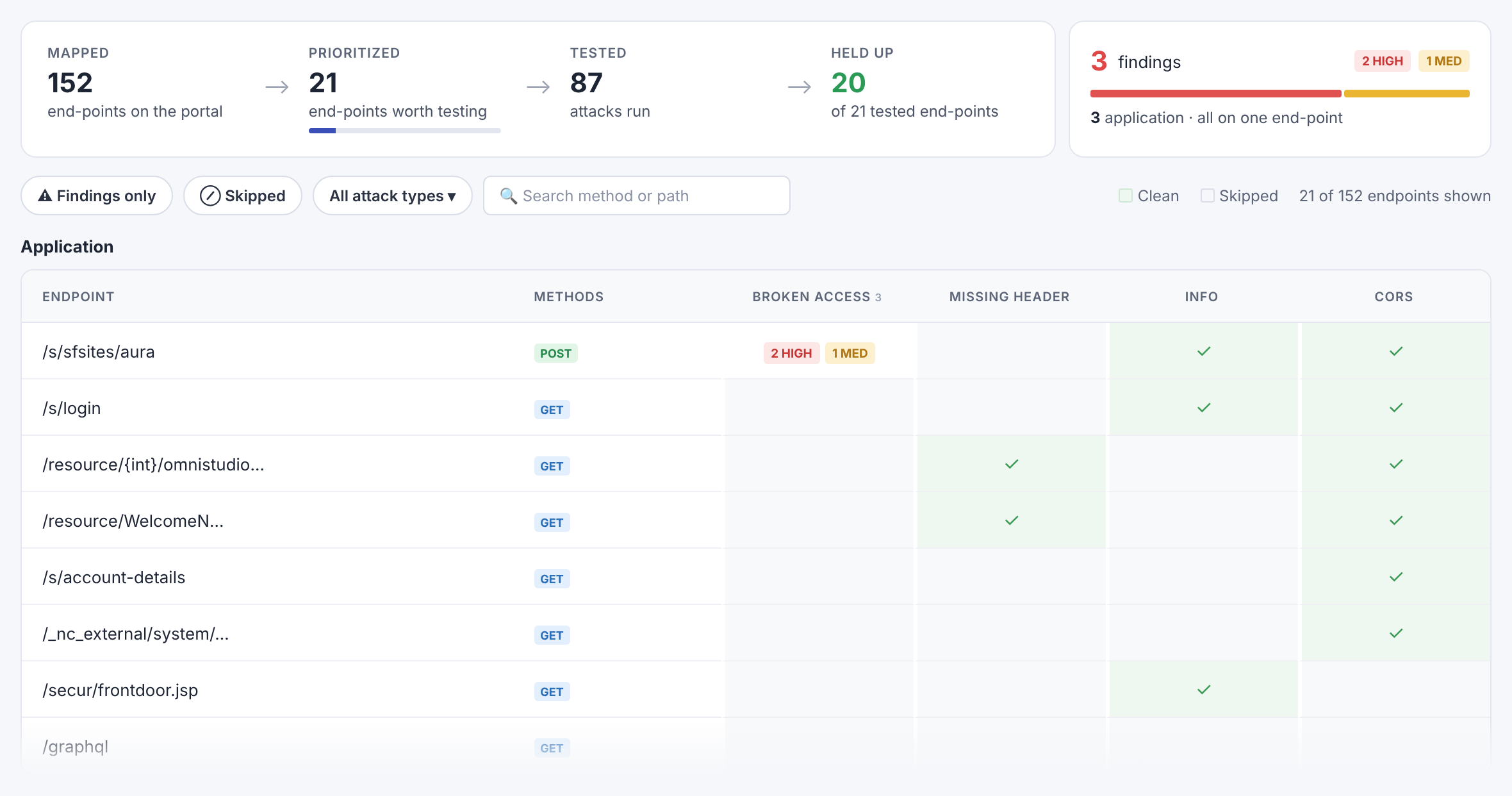
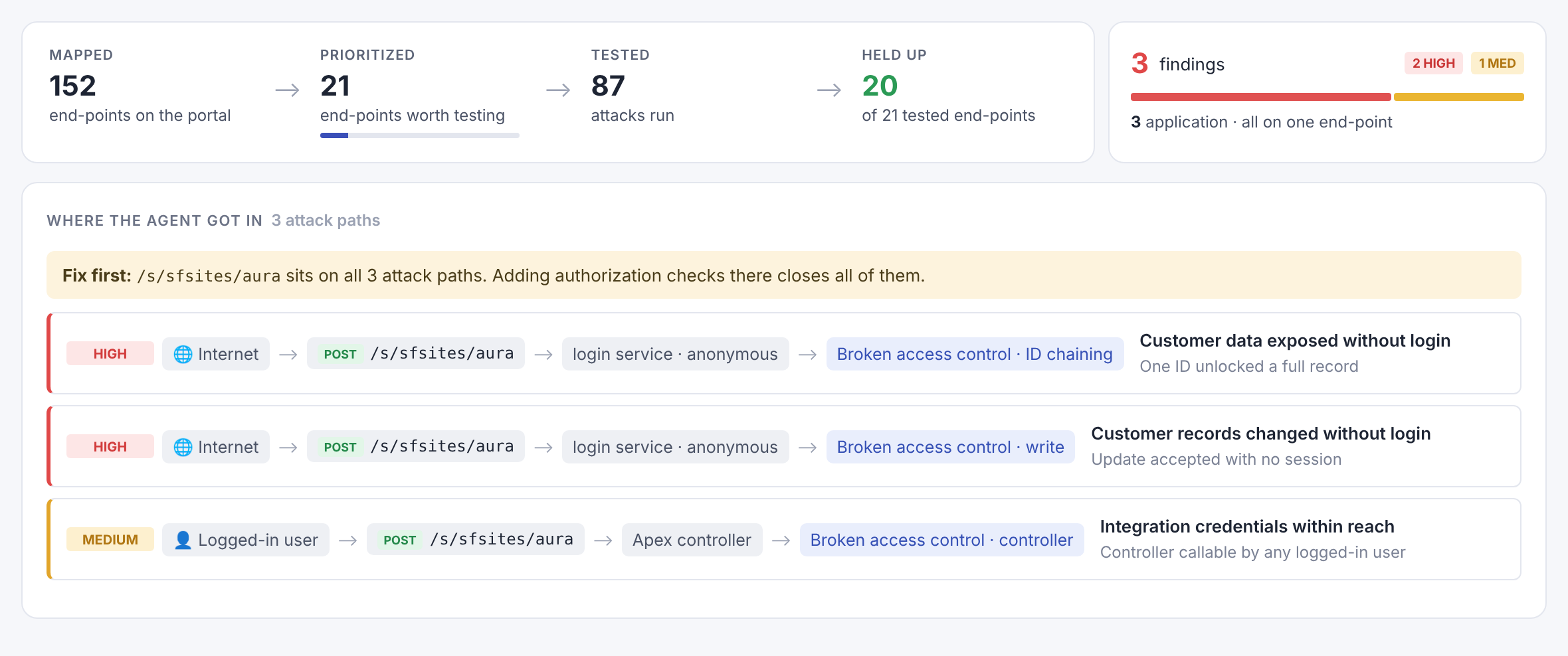
Looking up users, escalating privileges and reaching stored integration credentials are exactly the techniques Salesforce describes in the ARTEX campaign. Our agentic pentest proved the exposure safely on an authorized test account, with no real customer data touched.
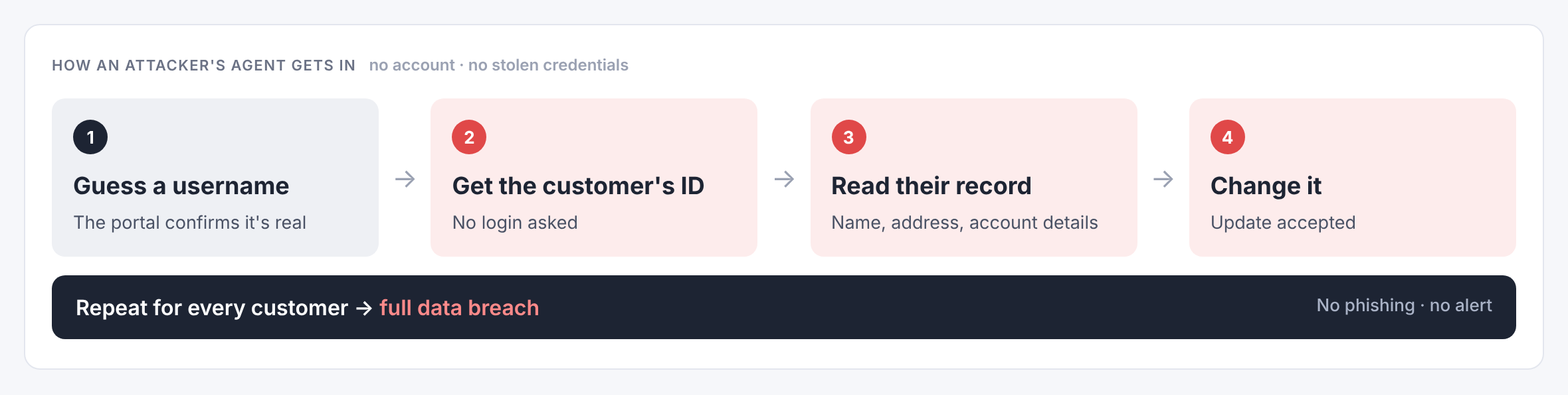
What does a missing authorization check mean in practice? ARTEX starts with stolen credentials. This portal didn’t even require those: an attacker’s AI agent tries a list of likely usernames, and the portal happily tells it which ones are real. It’s that easy! Nobody has to be tricked into clicking a link, and the requests look like normal site traffic, so no alarm goes off. For each match, the agent can see that person’s full name, address and account details, and change them. It can repeat this for every customer on the portal, turning a configuration gap into a full-scale data breach.
The customer’s security team was skeptical at first. It took a few meetings, and a review by their own Salesforce specialists, before the findings were confirmed.
“I have people from Salesforce security that have been doing this for a long time saying that it found things that they’ve never seen before.”
Why scanners and manual pentests miss these vulnerabilities
Traditional scanners test pages and match known CVEs. A guest-reachable Apex method with a missing check has no CVE. Its traffic looks like normal site use. Finding it takes reasoning: working out which functions an anonymous visitor can call, chaining their outputs together and proving the impact safely, as in the chain shown above.
Attackers now run AI agents that try every path at machine speed. Manual pentesting can’t match that pace. A human team tests for a few days, once or twice a year, while attacker agents probe around the clock. Defending against them takes agents of your own that reason through the same chains, run continuously and back every finding with evidence and a fix.
“Your agents are discovering things that years of pen testing haven’t discovered.”
CISO, US enterprise
What companies running sites on Salesforce should know
Salesforce’s guidance covers MFA, short-lived OAuth tokens, IP allowlisting and event monitoring. Those protect logged-in users and integrations. To protect what anonymous visitors can reach on an Experience Cloud site, also take these steps:
- Test the way hackers now attack. Run agentic pentests that chain findings together, and run them continuously.
- Apply least privilege to integrations. Give each connected app and integration only the access it actually needs.
- Never trust IDs sent from the browser. Bind every user lookup and update to the logged-in session.
- Review where Named Credentials can be reached. Stored integration secrets are a top ARTEX target.
Free trial
See what AI attackers would find on your site.
Start a Free TrialPrefer a guided walkthrough? Book an Offensive Hub demo
FAQs
What is ARTEX?
ARTEX is an open-source, multi-agent offensive framework originally built to automate penetration testing. An attacker gives it a target and a goal, and its AI agents plan, execute and retry new paths until one works. In November 2026, Salesforce reported that multiple threat actors are using it to break into Salesforce environments.
Is ARTEX exploiting a Salesforce vulnerability?
No. Salesforce says the activity did not come from a vulnerability in its platform. Attackers get in with stolen credentials and trusted integrations, then exploit how each company configured its own Salesforce environment. Salesforce can’t patch a customer’s configuration, so securing it is up to you.
What did the Reflectiz pentesting agent find on the Salesforce portal?
Three broken access control flaws, all on one endpoint, /s/sfsites/aura. Two were high severity: anonymous visitors could read and change customer records because the functions behind them had no authorization check. The third, medium severity, let any logged-in user call an Apex controller that reaches stored integration credentials.
Why do scanners and manual pentests miss these flaws?
Scanners test pages and match known CVEs. A guest-reachable Apex method with a missing authorization check has no CVE, and its traffic looks like normal site use. Manual pentests run a few days, once or twice a year. Finding these flaws takes an agent that reasons through the chain and proves the impact.
How do you protect a Salesforce Experience Cloud site from AI attackers?
Start with Salesforce’s guidance: MFA, short-lived OAuth tokens, IP allowlisting and event monitoring. Then cover what anonymous visitors can reach. Run agentic pentests continuously, give each integration only the access it needs, bind every user lookup and update to the logged-in session, and review where Named Credentials can be reached.
How often should you pentest a Salesforce portal?
Continuously. Attacker agents probe around the clock, while a manual pentest covers a few days once or twice a year. In this case, the CISO scheduled Reflectiz agentic pentests to run continuously, so every portal update gets tested as part of change management.
Subscribe to our newsletter
Stay updated with the latest news, articles, and insights from Reflectiz.
Related Articles


AI Has Changed The Web.
Are You Ready for What’s Next?
Third-party code shifts by the hour. Supply-chain compromises strike without warning. AI-driven web attacks now evolve faster than traditional security can ever keep up.
Reflectiz delivers the continuous, real-time visibility needed to expose the risks traditional tools miss entirely.
Zero code changes. Zero access to your data. Ultimate peace of mind.