Agentic Pentesting Guardrails: How Reflectiz Keeps Its AI Pentesters in Check


Autonomous offensive testing is only as trustworthy as the guardrails around it. Here’s how Reflectiz makes sure its AI pentesters mind their manners.
Definition
What are agentic pentesting guardrails?
Agentic pentesting guardrails are the controls that govern an autonomous AI pentester. They set what it tests, how deep it goes, and how it protects the applications it attacks. They let the agent attack your web applications like a real adversary without skipping coverage, reporting unproven findings, breaking production, or overstepping scope.
Agentic pentesting tools attack your web applications so you can fix what they find before an attacker does. The catch is trust. In July 2025, an AI coding agent on Replit deleted a user’s live production database during a code freeze.
Security leaders know the risk. In a 2026 Omdia study, 87% said they trust agentic AI for pentesting, yet 93% called comprehensive guardrails important or critical to running it safely.
Better models won’t fix this. They’re non-deterministic, they can’t reliably police themselves, and each gain in capability raises the cost of a mistake. Safety has to live in the system around the model.
Skipping AI pentesting isn’t safer. Exploitation is now the top way breaches start, at 31%, according to the 2026 Verizon DBIR. Reflectiz built Offensive Hub to attack like an adversary and behave like a guest. Here’s how.
What goes wrong without agentic pentesting guardrails?
AI pentesters fail in five predictable ways. A credible platform answers each one with a named control.
| Failure mode | What it looks like | What it costs you | Reflectiz guardrail |
|---|---|---|---|
| Wandering | Chases interesting bugs and skips the boring but critical parts of your app | Untested endpoints and false confidence | Full mapping and a record of what was tested |
| Crying wolf | Reports issues it hasn’t proven | Analyst hours lost to triage | Evidence-backed findings |
| Breaking things | Hammers production or triggers destructive actions | Downtime and damaged data | Deterministic checks and execution limits |
| Going out of bounds | Drifts past the scope you approved | Compliance and privacy exposure | Approved scope, schedule, and depth |
| Acting alone | Makes calls a human should make | Unreviewed risk in critical flows | Human oversight and stop controls |
Here’s how each guardrail works in practice.
Will it skip parts of your app? Full mapping and a coverage record
Left to itself, a large language model drifts the way people do. Ask it to test your application, and it chases whatever looks interesting, declares victory after the first good finding, and leaves the rest alone. It’s the biggest trap in continuous agentic pentesting.
Manual testing has this gap too. The same Omdia study found organizations test only 32% of their attack surface, leaving 68% untested. An agent that repeats that habit at machine speed doesn’t help you.
Others report what they found. Reflectiz shows what it tested. Reflectiz agentic pentesting maps every page and endpoint in your authorized scope, then prioritizes which attack paths to pursue. The dashboard shows what was tested and what was skipped, so gaps are visible instead of hidden.
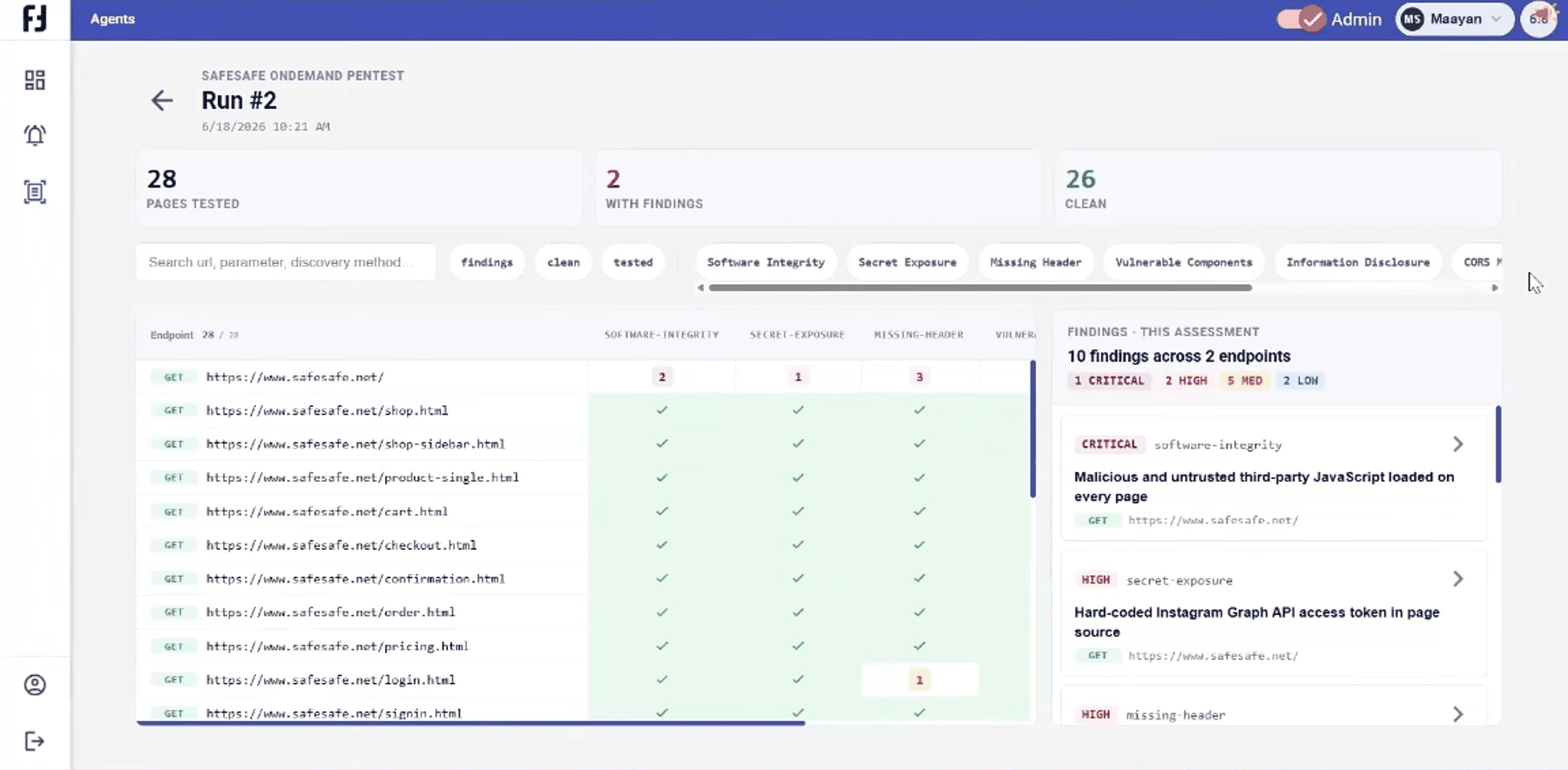
That visibility is the point. As Reflectiz CTO Ysrael Gurt puts it, “80% coverage is no longer good enough.” You can’t close a gap you can’t see.
Will it flood you with false positives? Evidence-backed findings
Every false positive costs analyst time. An over-eager agent can turn into a machine for generating triage work.
A scanner hands you possible vulnerabilities. Validated agentic pentesting hands you proof. Reflectiz adds a dedicated validation step that checks each potential exploit by executing and reproducing it. Confirmed findings come with that evidence, so your team can confirm them before anyone starts a fix.
Will it break production? Deterministic checks and execution limits
An agent that finds a way to take down production, then does it, has failed the one test that matters.
Reflectiz builds safety into the architecture of its agentic pentesting. Every action an AI model proposes goes through deterministic checks before a testing tool runs it. Is it in the authorized scope? Is the operation permitted? Is it within execution limits? Those checks run independently of the model’s reasoning. The model suggests. The rules decide.
Around that, destructive-payload filtering and time and execution limits constrain what a run can do, and your exclusions and custom rules keep sensitive areas off-limits. Access is checked before testing starts. Testing still sends real attack traffic, which is why these controls matter.
Guardrails aren’t a brake on testing. They’re what makes it practical to test production continuously instead of once a year.
Generalist pentesting tools treat the web like any other target. Reflectiz is purpose-built for it, backed by a decade of web security research and intelligence from over 100,000 websites.
Will it go out of bounds? Approved scope, schedule, and depth
An agent that drifts past its boundaries is an incident waiting to happen. The same deterministic checks reject any action outside the scope you approve.
You define exactly what to test, when, and how deeply. Run assessments on demand or on a schedule, or trigger them via API with every release, so new code gets tested without slowing delivery.
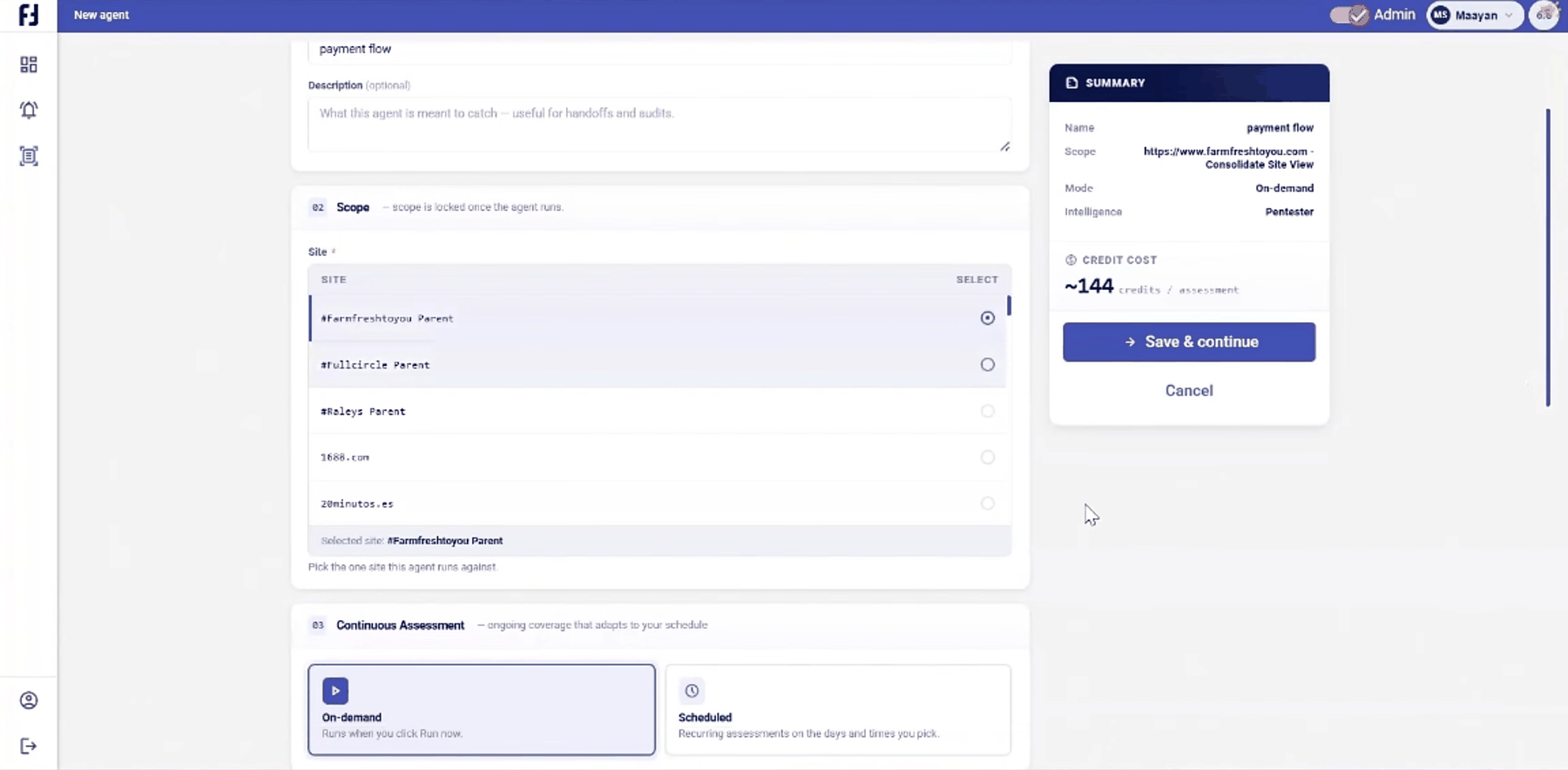
You also control how deep each assessment goes. Reflectiz offers four levels of testing intelligence, from deterministic scanning to advanced autonomous agents capable of deeper investigation and parallel attack exploration. Match the depth to the complexity and criticality of each asset.
Scoping starts with knowing what’s there. Reflectiz maps the applications, scripts, and components running on your website, and how sensitive data moves through them, so you can focus testing on your highest-risk flows.
Who makes the hard calls? Human oversight
Guardrails handle the routine. Judgment handles the rest. Most security leaders want it that way: in the same Omdia study, 64% preferred an agent-led model with human oversight.
Your team still makes the calls that matter: what to test, when, and how deeply, and which findings to fix first. Agentic pentesting multiplies what your team can do: the agents handle the broad, repetitive testing across your whole site, while your pentesters steer them and take on the most complex attack paths.
You can stop any assessment or deactivate an agent at any time.
How to evaluate a vendor’s agentic pentesting guardrails
Before any vendor’s autonomous agent touches production, ask one question: what’s the worst thing it could do, and what stops it? Most vendors answer by demoing how smart their agent is. That’s not enough.
A credible answer names a control for every failure mode. Ask:
- Can you prove everything you tested, not just what you found?
- What evidence comes with each finding?
- How do you protect production stability while you test?
- How do you keep testing inside the scope I approve?
- Where do humans stay in charge?
Go deeper: Our CISO guide to agentic pentesting includes ten questions to ask any vendor. To see how the field compares, read our roundup of the top agentic web-app pentesting tools.
Reflectiz agentic pentesting answers all five with named controls: full mapping with a coverage record, evidence-backed findings, deterministic checks and execution limits, approved scope, and human oversight with stop controls. You get the curiosity of a skilled attacker and the manners of a good guest.
See agentic pentesting guardrails on your own site
Free trial
Run Offensive Hub against your own web applications and check every guardrail yourself.
Start a Free TrialPrefer a guided walkthrough? Request a demo
FAQs
Is agentic pentesting safe to run on production websites?
It is when the right guardrails are in place. Look for deterministic checks on every action, filtering of destructive payloads, execution limits, and testing locked to the scope you approve. Reflectiz agentic pentesting applies all of these, and you can stop any assessment at any time.
How do you keep an AI pentester within scope?
Define exactly what to test, when, and how deeply before any run starts. In Reflectiz agentic pentesting, built-in guardrails keep every test within the scope you approve, whether you run assessments on demand, on a schedule, or via API with each release.
How do agentic pentesting tools avoid false positives?
Look for evidence, not just alerts. In Reflectiz agentic pentesting, every confirmed vulnerability includes supporting evidence and proof logs, so your team can validate it before starting a fix. You can also retest each vulnerability after remediation to confirm it is closed.
How do you prove what an AI pentester tested?
Ask for a record of what was tested, not just a findings list. Reflectiz agentic pentesting maps every page and endpoint in your authorized scope, then shows which items were tested and which were skipped, so you can see any gaps.
Does agentic pentesting replace human pentesters?
No. It multiplies what they can do. Agents handle the broad, continuous, repetitive testing across your whole site, while your red team or in-house pentesters focus on the most complex attack paths and on fixing what is found.
Won't better AI models make guardrails unnecessary?
No. A stronger model is still unpredictable from one run to the next, and it has no built-in way to stop itself from overstepping. More capability means bigger actions and costlier errors. In Reflectiz agentic pentesting, deterministic rules check every action a model proposes against scope, permitted operations, and execution limits before it runs, so the controls hold no matter how capable the model gets.
Subscribe to our newsletter
Stay updated with the latest news, articles, and insights from Reflectiz.
Related Articles



AI Has Changed The Web.
Are You Ready for What’s Next?
Third-party code shifts by the hour. Supply-chain compromises strike without warning. AI-driven web attacks now evolve faster than traditional security can ever keep up.
Reflectiz delivers the continuous, real-time visibility needed to expose the risks traditional tools miss entirely.
Zero code changes. Zero access to your data. Ultimate peace of mind.