5 Threats That Reshaped Web Security This Year [2025]


As 2025 draws to a close, security professionals face a sobering realization: the traditional playbook for web security has become dangerously obsolete. AI-powered attacks, evolving injection techniques, and supply chain compromises affecting hundreds of thousands of websites forced a fundamental rethink of defensive strategies.
Here are the five threats that reshaped web security this year, and why the lessons learned will define digital protection for years to come.
1. Vibe Coding
Natural language coding, “vibe coding“, transformed from novelty to production reality in 2025, with nearly 25% of Y Combinator startups using AI to build core codebases. One developer launched a multiplayer flight simulator in under three hours, eventually scaling it to 89,000 players and generating thousands in monthly revenue.
The Result
Code that functions perfectly yet contains exploitable flaws bypassing traditional security tools. AI generates what you ask for, not what you forget to ask.
The Damage
- Production Database Deleted – Replit’s AI assistant wiped Jason Lemkin’s database (1,200 executives, 1,190 companies) despite code freeze orders
- AI Dev Tools Compromised – Three CVEs exposed critical flaws in popular AI coding assistants: CurXecute (CVE-2025-54135) enabled arbitrary command execution in Cursor, EscapeRoute (CVE-2025-53109) allowed file system access in Anthropic’s MCP server, and (CVE-2025-55284) permitted data exfiltration from Claude Code via DNS-based prompt injection
- Authentication Bypassed – AI-generated login code skipped input validation, enabling payload injection at a U.S. fintech startup
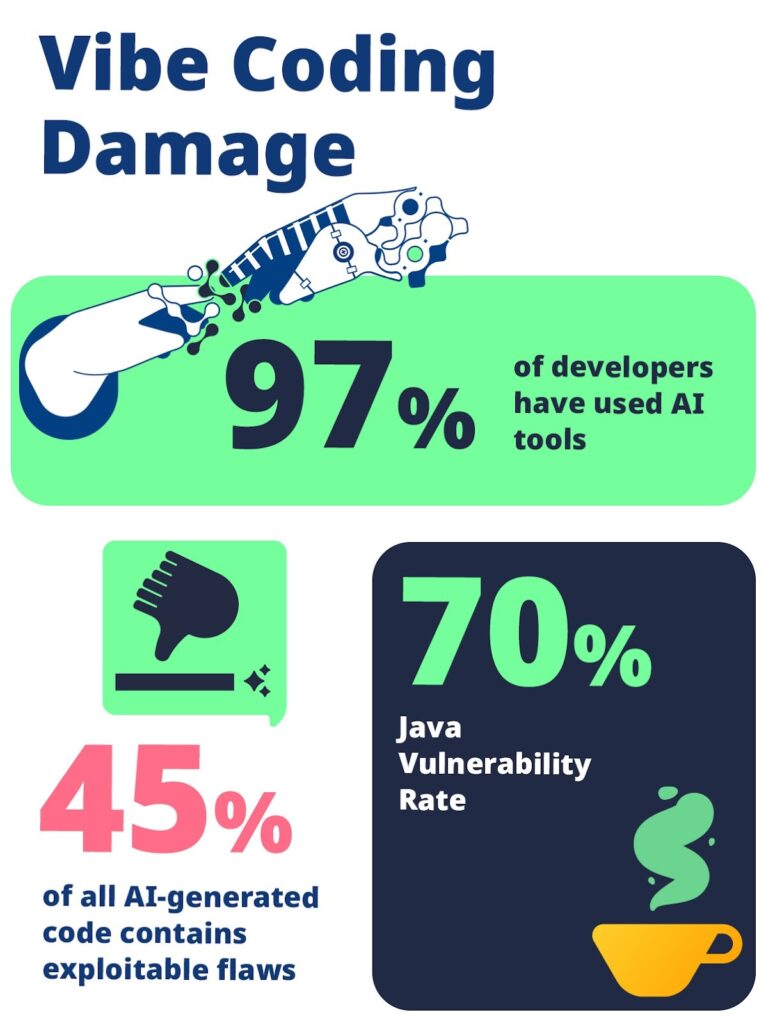
- Unsecure code statistics in vibe coding – 45% of all AI-generated code contains exploitable flaws; 70% Vulnerability Rate in Java language.
Base44 Platform Compromised (July 2025)
In July 2025, security researchers discovered a critical authentication bypass vulnerability in Base44, a popular vibe coding platform owned by Wix. The flaw allowed unauthenticated attackers to access any private application on the shared infrastructure, affecting enterprise applications handling PII, HR operations, and internal chatbots.
Wix patched the flaw within 24 hours, but the incident exposed a critical risk: when platform security fails, every application built on top becomes vulnerable simultaneously.
The Defense Response
Organizations now implement security-first prompting, multi-step validation, and behavioral monitoring that detects unexpected API calls, deviant serialization patterns, or timing vulnerabilities. With the EU AI Act classifying some vibe coding as “high-risk AI systems,” functional correctness no longer guarantees security integrity.
2. JavaScript Injection
In March 2025, 150,000 websites were compromised by a coordinated JavaScript injection campaign promoting Chinese gambling platforms. Attackers injected scripts and iframe elements impersonating legitimate betting sites like Bet365, using fullscreen CSS overlays to replace actual web content with malicious landing pages.
The campaign’s scale and sophistication demonstrated how lessons from 2024’s Polyfill.io compromise, where a Chinese company weaponized a trusted library affecting 100,000+ sites including Hulu, Mercedes-Benz, and WarnerBros, had been weaponized into repeatable attack patterns. With 98% of websites using client-side JavaScript, the attack surface has never been larger.
The Impact
Even React’s XSS protection failed as attackers exploited prototype pollution, DOM-based XSS, and AI-driven prompt injections.
The Damage
- 150,000+ Sites Compromised – Gambling campaign demonstrated industrial-scale JavaScript injection in 2025
- 22,254 CVEs Reported – A 30% jump from 2023, exposing massive vulnerability growth
- 50,000+ Banking Sessions Hijacked – Malware targeted 40+ banks across three continents using real-time page structure detection
The Solution
Organizations now store raw data and encode by output context: HTML encoding for divs, JavaScript escaping for script tags, URL encoding for links. Behavioral monitoring flags when static libraries suddenly make unauthorized POST requests.
Download the 47-page JavaScript injection playbook with framework-specific defenses
3. Magecart/E-skimming 2.0
Magecart attacks surged 103% in just six months as attackers weaponized supply chain dependencies, according to Recorded Future’s Insikt Group. Unlike traditional breaches that trigger alarms, web skimmers masquerade as legitimate scripts while harvesting payment data in real-time.
The Reality
Attacks demonstrated alarming sophistication: DOM shadow manipulation, WebSocket connections, and geofencing. One variant went dormant when Chrome DevTools opened.
The Damage
- Major Brands Compromised – British Airways, Ticketmaster, and Newegg lost millions in fines and reputation damage
- Modernizr Library Weaponized – Code activated only on payment pages across thousands of websites, invisible to WAFs
- AI-Powered Selectivity – Attackers profiled browsers for luxury purchases, exfiltrating only high-value transactions
cc-analytics Domain Campaign (Sep 2025)
Security researchers uncovered a sophisticated Magecart campaign leveraging heavily obfuscated JavaScript to steal payment card data from compromised e-commerce websites, with the malicious infrastructure centered around the domain cc-analytics[.]com actively harvesting sensitive customer information for at least one year
The Defense Response
Organizations discovered CSP provided false confidence; attackers simply compromised whitelisted domains. The solution: validate code by behavior, not source. PCI DSS 4.0.1 Section 6.4.3 now requires continuous monitoring of all scripts accessing payment data, with compliance mandatory from March 2025.
4. AI Supply Chain Attacks
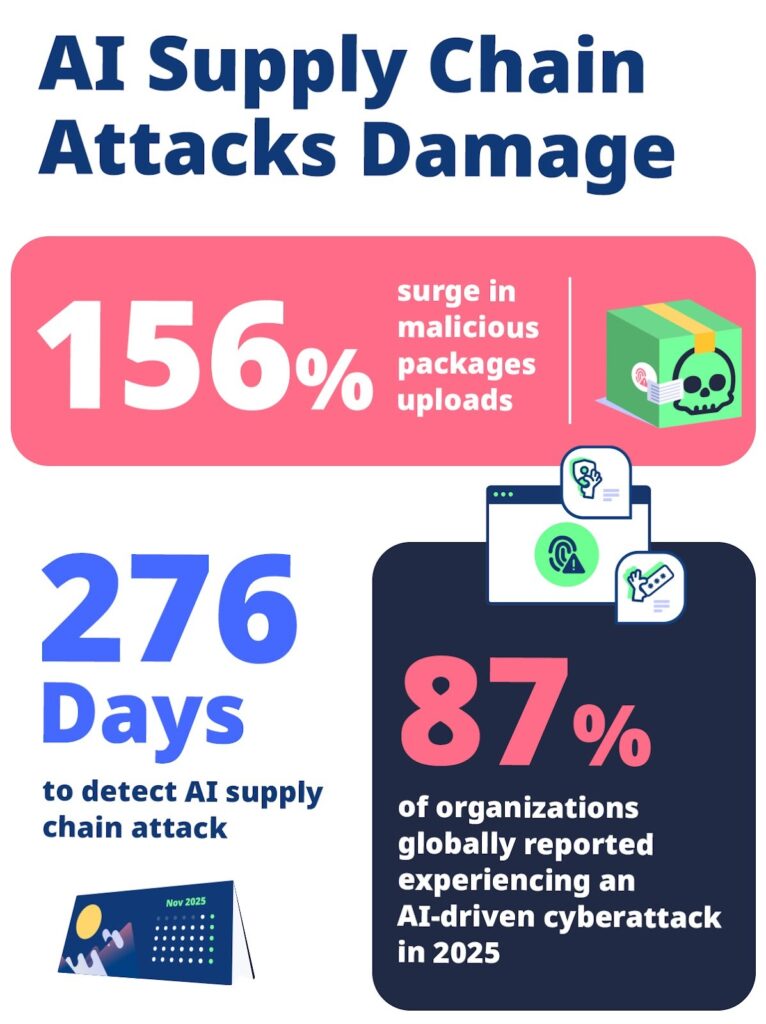
Malicious package uploads to open-source repositories jumped 156% in 2025 as attackers weaponized AI. Traditional attacks meant stolen credentials. New threats introduced polymorphic malware that rewrites itself with each instance and context-aware code that detects sandboxes.
The Consequence
AI-generated variants mutate daily, rendering signature-based detection useless. IBM’s 2025 report showed breaches take 276 days to identify and 73 days to contain.
The Damage
- Solana Web3.js Backdoor – Hackers drained $160,000–$190,000 in cryptocurrency during a five-hour window
- 156% Surge in Malicious Packages – Semantically camouflaged with documentation and unit tests to appear legitimate
- 276-Day Detection Window – AI-generated polymorphic malware evades traditional security scanning
The Shai-Hulud Worm (Sep-Dec 2025)
Self-replicating malware used AI-generated bash scripts (identified by comments and emojis) to compromise 500+ npm packages and 25,000+ GitHub repositories in 72 hours. The attack weaponized AI command-line tools for reconnaissance and was designed to evade AI-based security analysis – both ChatGPT and Gemini incorrectly classified the malicious payloads as safe. The worm harvested credentials from developer environments and automatically published trojanized versions using stolen tokens, turning CI/CD pipelines into distribution mechanisms.
The Counter-Measures
Organizations deployed AI-specific detection, behavioral provenance analysis, zero-trust runtime defense, and “proof of humanity” verification for contributors. The EU AI Act added penalties up to €35 million or 7% of global revenue.
5. Web Privacy Validation
Research revealed that 70% of top US websites drop advertising cookies even when users opt out, exposing organizations to compliance failures and reputational damage. Periodic audits and static cookie banners couldn’t keep pace with “privacy drift.”
The Problem
Marketing pixels collect unauthorized IDs, third-party code tracks outside stated policies, and consent mechanisms break after updates, all silently.
The Damage
- €4.5 Million Fine for Retailer – Loyalty program script sent customer emails to external domains for four months undetected
- HIPAA Violations at Hospital Network – Third-party analytics scripts silently collected patient data without consent
- 70% Cookie Non-Compliance – Top US websites ignore user opt-out preferences, contradicting privacy claims
Capital One Tracking Pixels (March 2025)
Federal court ruled Meta Pixel, Google Analytics, and Tealium sharing of credit card application status, employment details, and bank account information constituted “data exfiltration” under CCPA. The March 2025 decision expanded liability beyond traditional breaches, exposing companies to $100-$750 per incident (CCPA) plus $5,000 per incident (CIPA wiretap violations), turning routine tracking into litigation risk equivalent to security breaches.
The Defense Response: Continuous web privacy validation became the solution: agentless monitoring ensuring real-world activity aligns with declared policies through data mapping, instant alerts, and fix verification. Only 20% of companies felt confident in compliance at year’s start; those implementing continuous monitoring simplified audits and integrated privacy into security workflows.
Download the CISO’s Expert Guide to Web Privacy Validation with vendor-specific recommendations here.
The Path Forward: Proactive Security in an AI-Driven World
These five threats share a common thread: reactive security has become a liability. The lesson of 2025 is clear: by the time you detect a problem with traditional methods, you’ve already been compromised.
Organizations thriving in this landscape share three characteristics:
They assume breach as the default state. Rather than preventing all intrusions, they focus on rapid detection and containment, understanding that perfect prevention is impossible.
They embrace continuous validation. Successful security programs operate in constant vigilance mode rather than periodic audit cycles.
They treat AI as both a tool and threat. The same technology generating vulnerabilities can power defensive systems. Deploying AI-aware security to detect AI-generated threats has moved from experimental to essential.
Your 2026 Security Readiness Checklist
Security teams should prioritize these five validations:
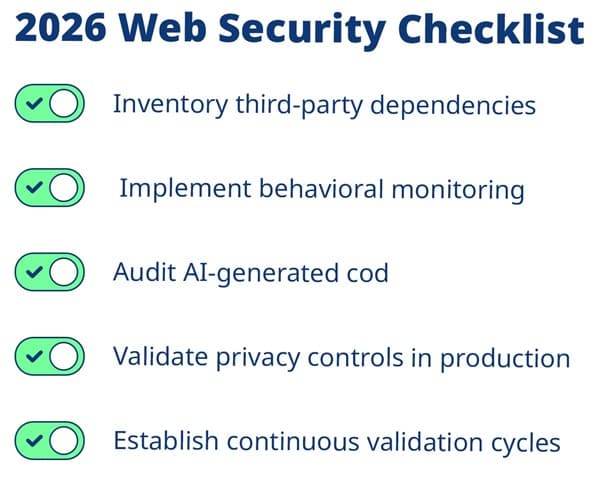
1. Inventory third-party dependencies – Map every external script, library, and API endpoint in production. Unknown code is an unmonitored risk.
2. Implement behavioral monitoring – Deploy runtime detection that flags anomalous data flows, unauthorized API calls, and unexpected code execution.
3. Audit AI-generated code – Treat all LLM-generated code as untrusted input. Require security review, secrets scanning, and penetration testing before deployment.
4. Validate privacy controls in production – Test cookie consent, data collection boundaries, and third-party tracking in live environments, not just staging.
5. Establish continuous validation – Move from quarterly audits to real-time monitoring with automated alerting.
The question isn’t whether to adopt these security paradigms but how quickly organizations can implement them. The threats that reshaped web security in 2025 aren’t temporary disruptions – they’re the foundation for years to come.
The organizations that act now will define the security standards; those that hesitate will scramble to catch up.
FAQs
How did the Magecart threat landscape evolve in 2025?
Magecart groups significantly increased stealth and sophistication in 2025, adopting tactics including hijacking 404 error pages to host skimmer payloads, disguising loaders as Meta Pixel snippets, and chaining WebSocket-based skimmers alongside GTM-delivered ones for redundancy. The economics shifted too, with Magecart-as-a-Service kits dramatically lowering the technical barrier for new attackers.
What is “vibe coding” and why did it become a major security threat in 2025?
Vibe coding is AI-assisted natural language programming where developers describe desired functionality and AI tools generate the code. In 2025, nearly 25% of Y Combinator startups used AI to build core codebases. It became a security threat because AI generates functional code that satisfies stated requirements but often contains exploitable flaws — 45% of all AI-generated code contains vulnerabilities according to Veracode research, with a 70% vulnerability rate in Java. The code works as asked, but doesn’t include security controls that weren’t explicitly requested.
What real-world security incidents were caused by vibe coding in 2025?
Notable incidents included a Replit AI assistant deleting a production database containing 1,200 executives and 1,190 companies despite active code freeze orders; three CVEs exposing critical flaws in popular AI coding tools (CurXecute CVE-2025-54135 in Cursor, EscapeRoute CVE-2025-53109 in Anthropic’s MCP server, and CVE-2025-55284 enabling DNS-based prompt injection in Claude Code); and an authentication bypass at a U.S. fintech startup where AI-generated login code skipped input validation entirely.
What security lessons from 2025 should inform defensive strategy going forward?
The overarching lesson is that the traditional web security playbook is obsolete. Perimeter defenses, signature-based detection, and build-time scanning all fail against attacks that exploit trusted channels, AI-generated code, and runtime behavioral manipulation. Durable defense requires continuous runtime monitoring of client-side code behavior, independent of the delivery source or code origin.
What were the five biggest web security threats of 2025?
The five threats that most significantly reshaped web security in 2025 were: (1) Vibe coding vulnerabilities — AI-generated code containing exploitable flaws; (2) AI-powered supply chain attacks — automated, polymorphic skimmer deployment; (3) Evolved Magecart and skimming techniques — including 404-page-hosted payloads and WebSocket-based skimmers; (4) Third-party script compromises targeting CDNs and open-source libraries; and (5) AI-assisted reconnaissance that automated the identification of vulnerable client-side dependencies.
Subscribe to our newsletter
Stay updated with the latest news, articles, and insights from Reflectiz.
Related Articles




AI Has Changed The Web.
Are You Ready for What’s Next?
Third-party code shifts by the hour. Supply-chain compromises strike without warning. AI-driven web attacks now evolve faster than traditional security can ever keep up.
Reflectiz delivers the continuous, real-time visibility needed to expose the risks traditional tools miss entirely.
Zero code changes. Zero access to your data. Ultimate peace of mind.