Agentic Pentesting for Websites: A CISO’s Guide to Closing the Exploit Gap


Attackers now weaponize new vulnerabilities in about five days (Mandiant, part of Google Cloud). The median organization takes 43 days to patch one (Verizon DBIR 2026). Agentic pentesting for websites closes that gap with autonomous AI agents that test on every release, not once a year.
This guide covers why the annual pentest fails, how four testing approaches handle one real bug, the three design choices that separate platforms from demos, and what you must demand before pointing an AI agent at production. For the full playbook, get the free CISO’s Expert Guide to Agentic Pentesting.
TL;DR
- Exploitation is now the front door. It starts 31% of breaches (Verizon DBIR 2026), the #1 initial-access vector, while annual pentesting leaves an estimated 90% of the estate untested.
- The capability is proven, not projected. An autonomous system topped HackerOne’s US leaderboard in 2025 (XBOW), and peer-reviewed agents exploited 87% of one-day flaws unaided (Fang et al., 2024).
- Continuous beats periodic, measurably. Programmatic testing makes teams 4.5x more likely to fix criticals within three days (Cobalt, 2026).
- It’s an AI agent in your production. Hold it to a bar. Provable coverage, an independent validator, blast-radius guardrails, and an audit trail, or no deal.
- The economics favor adoption. One ~$18K manual engagement (industry estimate) against a $4.44M average breach (IBM, 2025).
Definition
What is agentic pentesting for websites?
Agentic pentesting for websites is penetration testing run by autonomous AI agents that work through a site like a real user. They log in, map every page, form, and API, chain findings into full exploit paths, and validate each one before it reaches the report. It runs on every release instead of once a year, so coverage keeps pace with how fast your web estate changes.
Watch: why 90% of your web assets go untested
The Annual Pentest Is Stale Before It Ships
Pentesting has barely changed in a decade, but it has to, because attackers no longer work on a yearly timetable. Against an adversary who moves in days, the annual engagement, the long PDF, and the fix list that’s stale on arrival are too slow. The forces that made the periodic model untenable all show up in the 2026 industry data.
Exploitation took the lead. Verizon’s 2026 DBIR, built on 22,000+ confirmed breaches, marks the turning point: vulnerability exploitation overtook stolen credentials as the most common way in.
Remediation moved the other way. Median time to patch a known-exploited flaw rose from 32 to 43 days, and the share of CISA KEV catalog flaws actually patched fell from 38% to 26%.
Attackers move in days, defenders in weeks. Google Mandiant telemetry puts average time-to-exploit at roughly five days. Cobalt’s 2026 State of Pentesting puts the median time to resolve a high-risk finding at 39 days, with a 25x gap between the best and worst performers. A defender on a 43-day clock facing an adversary who moves in five isn’t managing that risk so much as documenting it after the fact.
AI broke the point-in-time model on both sides. Attackers use AI to find and weaponize flaws faster. Your own developers use AI to ship code faster than any human team can test it, and Cobalt finds AI/LLM applications carry high-risk findings at 2.7x the rate of traditional apps.
The 2026 exposure gap at a glance
| Metric | 2026 figure | Source |
|---|---|---|
| Breaches that start with vulnerability exploitation | 31%, the #1 initial-access vector | Verizon DBIR 2026 |
| Median time to patch a known-exploited flaw | 43 days (up from 32) | Verizon DBIR 2026 |
| CISA KEV catalog flaws actually patched | 26% (down from 38%) | Verizon DBIR 2026 |
| Average time-to-exploit | About 5 days | Google Mandiant |
| Median time to resolve a high-risk pentest finding | 39 days | Cobalt, State of Pentesting 2026 |
| High-risk finding rate, AI/LLM apps vs. traditional apps | 2.7x | Cobalt, State of Pentesting 2026 |
| Web estate an annual pentest leaves untested | About 90% (estimate) | Reflectiz cost analysis |
A snapshot taken once a year, covering a tenth of the estate, delivered weeks late, against an adversary who moves in five days. That is the gap agentic pentesting exists to close.
One Bug, Four Outcomes
Here is what the difference looks like against a single, common attack chain: an IDOR (insecure direct object reference) in an authenticated account area.
An attacker logs into an ordinary account, changes the account_id on a profile-update request, and discovers the app never checks ownership. They enumerate IDs at scale, rewrite other users’ email addresses, trigger password resets, and walk away with full account takeover. No CVE. No malformed input. Just business logic the app got wrong.
This exact bug class exposed 885 million mortgage and title records at First American Financial in 2019: change one digit in a document link, see someone else’s file.
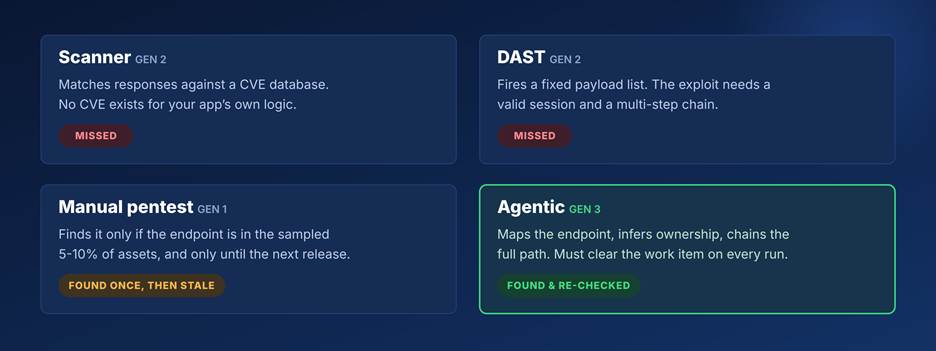
| Approach | How it handles the IDOR chain | Outcome |
|---|---|---|
| Vulnerability scanner (Gen 2) | Matches responses against a CVE database. No CVE exists for your app’s own logic. | Missed |
| DAST (Gen 2) | Fires a fixed payload list. The exploit needs a valid session and a multi-step sequence no payload list contains. | Missed |
| Manual pentest (Gen 1) | Finds it, if this endpoint happens to fall inside the sampled 5-10%, and only until the next release. | Found once, then stale |
| Agentic pentesting (Gen 3) | Maps the endpoint, infers the ownership relationship, and chains enumeration to email rewrite to password reset. That work item must clear on every run. | Found & re-checked |
Explore the full three-generation comparison and vendor evaluation criteria in the CISO Guide, including the ten questions that expose a wrapped LLM.
Three Design Choices That Separate Platforms From Demos
The category’s failure mode is DAST with an LLM bolted on: the same fixed payload list underneath, with nondeterministic coverage layered on top. What separates a platform is architecture, not model choice, and it shows up in three places.
1. Work-item-enforced coverage
If the AI decides what to test, coverage becomes unprovable: the model drifts toward interesting findings and quietly skips the rest. Demand a full test matrix generated up front, every endpoint against every applicable attack category, as non-skippable work items. The AI should be adaptive in how it attacks each item, never in whether it does. Our continuous agentic pentesting framework shows how to enforce this in practice.
2. An independent validator agent
A finding should enter the report only after a separate agent reproduces it. That moves false-positive elimination into the architecture instead of onto your team’s triage queue, the hidden tax that makes many scanning tools net-negative on analyst time.
3. A browser-native agent
Most agentic tools are effectively curl with a model attached. Real websites break them: dynamic rendering, one-time passcodes, MFA, anti-bot defenses. The agent must drive a real browser, hold session state, and reconstruct user intent, or the business logic beneath the surface goes untested. See what that looks like in our Offensive Hub walkthrough, or compare the top 10 agentic web-app pentesting tools of 2026.
“80% coverage is no longer good enough, because attackers only need the one gap you missed.”
Govern It Like the Autonomous Agent It Is
An agentic pentesting tool is two things at once: a control that reduces risk, and an autonomous AI system running against your own environment. The guide’s governance checklist covers what to require before the first authorized run:
- Explicit, revocable scoping
- Blast-radius guardrails with an immediate safe-stop
- Data isolation, with zero access to customer-data infrastructure
- A complete, exportable audit trail
- Defined human oversight
- Vendor assurance
The test is simple. If you cannot answer “what is the worst thing this agent can do to production, and what stops it?” you are not ready to authorize a run.
The Budget Math and the Audit Dividend
A manual engagement averages ~$18.3K before the common 30-50% overrun, and a mature program still spends $150K+ a year to test an estimated 5-10% of its assets (Reflectiz cost analysis of published vendor pricing). The question for the board isn’t which quote is cheapest. What matters is coverage-adjusted risk reduction per dollar: agentic platforms report up to 10x testing capacity at the cost of one manual engagement, and every endpoint covered continuously is one fewer path to a seven-figure breach.
There is a compliance dividend too. Continuous, documented testing produces the evidence for the “after significant change” clauses in PCI DSS 4.0.1 that annual testing structurally cannot, and maps to control and assurance activities under DORA, NIS2, SOC 2, ISO 27001, GDPR Article 32, and HIPAA. Every run generates its own evidence pack: a coverage matrix, validated findings with reproduction steps, and trend reporting your auditors can query. The guide maps each framework to the evidence continuous testing produces.
What’s Inside the Full Guide
- The 2026 exposure data, visualized
- The ten vendor questions, with the red flags that expose wrapped LLMs
- The governance controls to put in the contract
- The agentic pentesting vendor landscape, mapped
- Four pricing models, and what each one punishes
- A 90-day adoption roadmap with the KPIs to hold it accountable
- The 11-point CISO checklist
The strategic question has moved past manual vs. automated. What matters now is how you get continuous, provable, validated coverage across your whole web portfolio, safely, and at a cost you can defend.
A version of this article was originally published on The Hacker News.
FAQs
What should CISOs demand from an agentic pentesting vendor?
Three architecture choices separate a platform from a demo. First, work-item-enforced coverage: a full test matrix of every endpoint against every applicable attack category, generated up front and non-skippable. Second, an independent validator agent that reproduces each finding before it reaches the report. Third, a browser-native agent that handles dynamic rendering, one-time passcodes, MFA, and anti-bot defenses. A tool without them is often DAST with an LLM bolted on, a “wrapped LLM.”
Why do scanners and DAST miss business logic flaws like IDOR?
Scanners match responses against a CVE database, and no CVE exists for your application’s own logic. DAST fires a fixed payload list, but an IDOR account-takeover chain needs a valid session and a multi-step sequence that no payload list contains. Finding it takes an agent that maps the endpoint, infers who owns each record, and chains enumeration, email rewrite, and password reset into one exploit path.
Is it safe to run an AI pentesting agent against production websites?
It can be, if you govern it like the autonomous AI system it is. Before the first authorized run, require explicit and revocable scoping, blast-radius guardrails with an immediate safe-stop, data isolation with zero access to customer-data infrastructure, a complete exportable audit trail, defined human oversight, and vendor assurance. If you cannot say what the worst thing the agent can do to production is, and what stops it, you are not ready.
How do you make the budget case for agentic pentesting?
Compare coverage, not quotes. A manual engagement averages about $18.3K before the common 30-50% overrun, and a mature program can spend $150K+ a year to test an estimated 5-10% of its assets. Agentic platforms report up to 10x the testing capacity for the cost of one manual engagement. Measure coverage-adjusted risk reduction per dollar against a $4.44M average breach (IBM, 2025).
What compliance evidence does continuous pentesting produce?
Continuous, documented testing produces evidence for the “after significant change” clauses in PCI DSS 4.0.1, which annual testing structurally cannot. It also maps to control and assurance activities under DORA, NIS2, SOC 2, ISO 27001, GDPR Article 32, and HIPAA. Each run generates an evidence pack: a coverage matrix, validated findings with reproduction steps, and trend reporting your auditors can query.
How long does it take to roll out agentic pentesting?
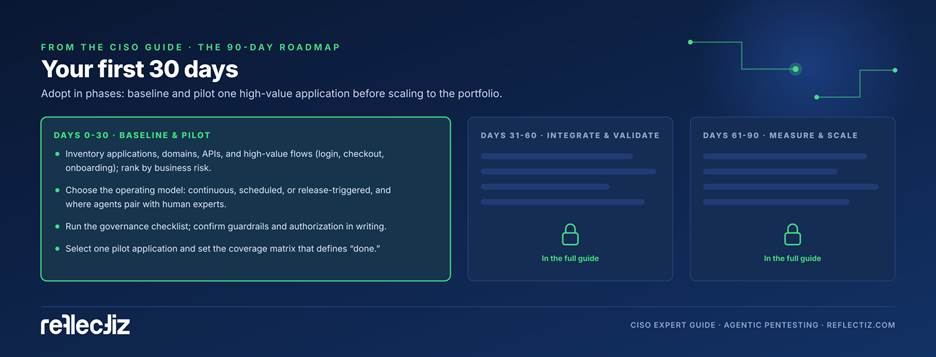
The CISO guide lays out a 90-day roadmap in three phases. Days 0-30: inventory applications, domains, APIs, and high-value flows, choose the operating model, run the governance checklist, and pilot one application with a defined coverage matrix. Days 31-60: integrate and validate. Days 61-90: measure results against KPIs and scale to the rest of the web portfolio.
Subscribe to our newsletter
Stay updated with the latest news, articles, and insights from Reflectiz.
Related Articles

AI Has Changed The Web.
Are You Ready for What’s Next?
Third-party code shifts by the hour. Supply-chain compromises strike without warning. AI-driven web attacks now evolve faster than traditional security can ever keep up.
Reflectiz delivers the continuous, real-time visibility needed to expose the risks traditional tools miss entirely.
Zero code changes. Zero access to your data. Ultimate peace of mind.