Secure Your Entire Web Application Supply Chain
Prevent vulnerabilities in your web app supply chain, and ensure all your web components are being used as intended


Your Web Application is No Longer Yours
The modern web application is becoming increasingly complex, relying on dozens of third-party web components, open source tools, and JS frameworks—all hosted on vendor servers, CDNs, and external repositories. This means that many web components are controlled externally, rather than by you. Even if you have gone through all of your SSDLC processes, you are only securing certain parts of your web application in its current state.
The Hidden Risks in Your Supply Chain
Standard security processes do not monitor your entire supply chain, so there are many potential risks that they will simply miss. For example:


Standard security controls will leave you vulnerable in these and many similar scenarios.


Safeguard Your Web Application:
From Release and Beyond
Due to the dynamic nature of both your in-house and third-party web components, as well as the involvement of external providers beyond your control, it is crucial to maintain continuous monitoring of all web assets. This ensures that any changes made to these applications are promptly detected and assessed for potential vulnerabilities.
Remember, vulnerabilities are not stopping on release.
Reflectiz’s continuous monitoring helps you complete the SSDLC from the moment of release into production and beyond to maintain a robust security posture throughout.
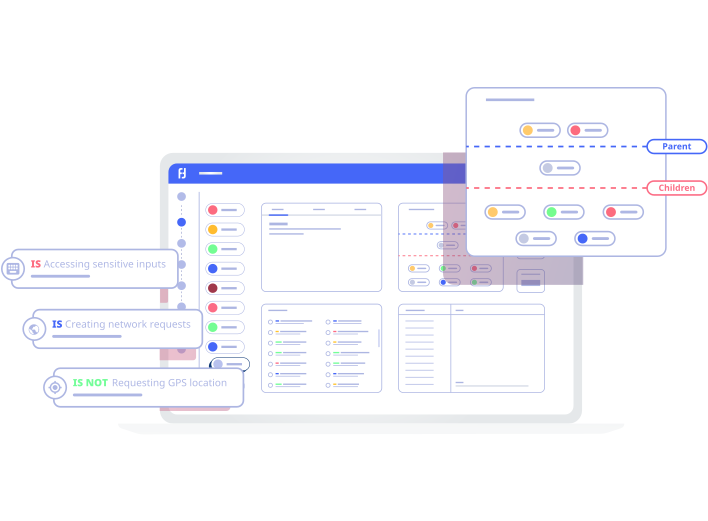

Down the Rabbit Hole of Third-Parties
With Reflectiz, you can keep your web application supply chain completely secure – going into production, and beyond.

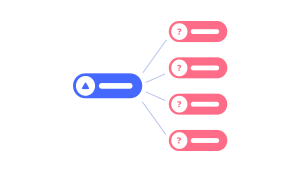


New security compliance requirements demand complete, continuous visibility into your web supply chain, and that’s exactly what Reflectiz can offer your business
FAQs
Can tag manager misconfigurations create supply chain risk?
Yes. Tag managers such as Google Tag Manager are designed to allow marketing and analytics teams to deploy tracking pixels and scripts without engineering involvement. This convenience comes with risk: a misconfigured tag can cause a third-party tracking script to capture and transmit PII that was never intended to be shared with that vendor. In regulated industries, this type of unintended data collection can constitute a privacy violation under GDPR or CCPA even if no malicious actor is involved. Reflectiz monitors tag manager output to ensure that only approved data flows to authorized destinations, regardless of how tags are configured.
How do regulatory frameworks like PCI DSS and GDPR create requirements for web supply chain security?
Both PCI DSS v4.0.1 and GDPR impose obligations that directly address web supply chain risk. PCI DSS now requires merchants to inventory all scripts on payment pages, ensure script integrity, and implement monitoring for unauthorized access to payment form fields — obligations that third-party supply chain compromises can violate without any action by the merchant. GDPR mandates that organizations maintain control over how personal data is collected and processed; a third-party script that unexpectedly begins collecting additional PII can create a compliance violation even though the merchant did not deliberately instruct the script to do so. DORA, HIPAA, and emerging AI-specific regulations are extending similar requirements into financial services, healthcare, and AI-powered web applications.
How does Reflectiz help organizations manage web supply chain risk?
Reflectiz provides complete runtime visibility into the web application supply chain through five core capabilities. It identifies all web assets — first-party and third-party — currently loading on a site and maps their dependencies. It monitors the behavior of third-party code, flagging changes in what data those scripts access or where they transmit information. It prioritizes the access that web components have to sensitive business and customer data, enabling risk-based triage. It surfaces compliance issues as they arise, including post-release regulatory violations introduced by vendor updates. And it validates that SSDLC controls continue to function as intended after deployment, not just at the point of release.
What are the most common types of web supply chain attack targeting organizations today?
The most prevalent web supply chain attacks exploit the trust that organizations place in their third-party dependencies. Compromised CDN-hosted libraries can serve malicious payloads to every site that loads them. npm and open-source repository poisoning introduces malware into widely used JavaScript packages. Vendor account takeover — where attackers steal developer credentials through phishing — allows them to push malicious updates that appear to come from a legitimate source. Domain expiry attacks involve purchasing an expired domain that previously served a legitimate script, then serving malicious code from the same URL. Each of these techniques exploits the reality that organizations cannot vet every line of code delivered by every third party at runtime.
What hidden risks exist in a web supply chain that standard SSDLC processes miss?
Secure Software Development Lifecycle (SSDLC) processes are designed to assess code at the time of development and release. However, the web supply chain is dynamic: a third-party vendor can release a new version of their script at any time, and that new version begins running in production immediately. Standard SSDLC processes cannot evaluate code that is introduced after deployment. This creates four categories of hidden risk: a vendor update that introduces a security or privacy compliance violation, a vendor’s external server being compromised and serving malicious payloads, a post-production vulnerability discovered in a component already in use, and tag manager misconfigurations that cause unintended PII collection.
What is a web application supply chain, and why is it a security concern?
A web application supply chain encompasses every external component, library, script, or service that a website loads and executes. Modern web applications typically depend on dozens of third-party elements: JavaScript frameworks hosted on CDNs, analytics and marketing pixels, chat widgets, payment processors, tag managers, and open-source libraries pulled from repositories like npm. Because these components are hosted on vendor servers and delivered dynamically at runtime, they are often outside the direct control of the organization running the website. If any vendor in this chain is compromised, the malicious code they deliver runs with the same trust as the site’s own first-party code — inside every visitor’s browser.
What is the difference between first-party and third-party web supply chain risk?
First-party supply chain risk involves components developed or directly controlled by the organization — their own JavaScript, configuration files, and application logic. These risks are generally addressed through secure development practices, code review, and deployment pipelines. Third-party supply chain risk involves code written and hosted by external vendors, delivered dynamically at runtime. Third-party risks are more difficult to manage because the organization has limited visibility into vendor security practices, no direct control over when or how vendor code is updated, and often no real-time mechanism to detect when a previously benign third-party script changes its behavior. Third-party risk is the primary focus of web supply chain security solutions like Reflectiz.
Why is continuous monitoring necessary even after a web application passes security review?
Security review validates a web application at a specific point in time. But the live application is a continuously changing environment: vendors push script updates, CDN configurations change, new marketing tags are added by non-technical teams, and previously undiscovered vulnerabilities are disclosed in components already running in production. Without continuous runtime monitoring, there is no mechanism to detect these post-release changes. Reflectiz fills this gap by observing what scripts are loaded and how they behave on an ongoing basis, extending the SSDLC from the moment of release into production indefinitely.