Security teams prefer Reflectiz over c/side. Here’s why:
Proactive defenses are crucial for securing your web environment in today’s digital landscape. Discover the key differences between Reflectiz and c/side and see how the two tools compare.


no installation required
detects 20%-50% more scripts
rating system
Trusted by top companies:















C/side published a comparison page making specific technical claims about Reflectiz. Our co-founders read it carefully. Here’s the full technical record — with evidence, named customers, and corrections where their claims don’t hold up.
cside vs Reflectiz: What the Technical Record Actually Shows
By Idan Cohen & Ysreal Gurt, Co-Founders, Reflectiz – Last updated May 2026

TL;DR
- Reflectiz monitors from outside the browser. C/side runs code inside the same environment as the attacker.
- C/side cannot see cross-origin iframes — where most payment skimmers live — by design.
- C/side transmits real user session data including full page URLs to their servers. Reflectiz transmits none.
- 29 verified G2 reviews for Reflectiz vs. 11 for cside. Named enterprise customers vs. anonymized reviewers.
- C/side’s comparison page uses pre-seeded AI prompts to manufacture “independent” validation. We explain why below.
Reflectiz is a continuous web exposure management platform that detects third-party threats, maps your full web supply chain to the fourth party, blocks malicious scripts on demand — and does all of it without persistent code running on your site, without developer involvement, and without transmitting user data to external servers.
This page compares Reflectiz and c/side on the evidence that actually exists: verified review data, documented architecture, named customer deployments, and an active working relationship with Integrity360. Where c/side has a genuine advantage, we say so. Where their published comparison contains factual errors or technical misrepresentations, we correct them with specifics. We encourage buyers to verify every claim on this page — and on c/side’s — independently. The data is publicly available.
The G2 picture — what the numbers actually show
C/side’s comparison page lists Reflectiz at 4.7 stars on G2. That figure is correct. What their page omits is the context that makes the comparison meaningful.
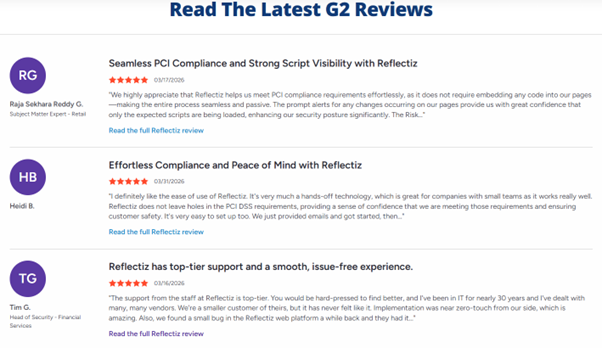
Reflectiz has 29 verified G2 reviews. C/side has 11. Reflectiz’s review base is nearly three times larger — built from enterprise security practitioners across eCommerce, financial services, and healthcare making real purchasing decisions in production environments. C/side’s marginally higher average rating comes from less than half the review volume.
G2 High Performer status is held by both vendors. The difference is that Reflectiz’s is earned from a volume of verified customer evidence that c/side has not yet matched.
Review volume matters in security vendor selection because it reflects how many organizations have gone through procurement, deployed the product, and formed a considered opinion worth documenting publicly. 29 organizations have done that for Reflectiz. 11 have done it for c/side.
Read the Reflectiz G2 reviews here: g2.com/products/reflectiz/reviews
What customers say
The customer record between Reflectiz and c/side is not close in volume or specificity, and that gap matters.
Reflectiz customers speak in operational detail, with named individuals and documented outcomes.
Keyur Lavingia, Head of Security at Village Roadshow, described Reflectiz’s role in what he called a seamless PCI DSS 4.0.1 audit — a collaborative effort across teams that gave the organization confidence going into compliance review.
At lastminute.com, Director of Platform Security Alessandro Gazzoni noted that previous script monitoring capabilities were never going to satisfy the requirements for actionable alerting, compliance reporting, evidence generation, and supply chain governance that PCI DSS 4.0.1 demands — and that Reflectiz filled that gap ahead of their first audit.
Broadway Gaming Group’s CISO Kfir Tzukrel passed his first PCI DSS 4.0.1 audit with zero observations and zero developer overhead, with audit evidence exported cleanly using Reflectiz’s AI-assisted script justification tools.
Castore’s security team discovered a fourth-party vulnerability that the script vendor itself had missed, and uncovered a single ad tag silently calling dozens of undisclosed external domains — threats that were invisible until Reflectiz mapped the full downstream chain across their 30+ online stores.
At Lion, the CISO specifically evaluated Reflectiz against competing solutions and chose it — describing the platform as giving their team efficient management of website security across a complex multi-brand web estate.
On onboarding specifically, Deepak K. Ramanujam, Head of Security at Apexx Global, put it directly: “I was shocked. From handing over the URLs to seeing a fully active dashboard was less than 24 hours. It was the most frictionless implementation I’ve ever experienced.” Read the full story here: reflectiz.com/blog/apexx-pci-dss-success/
C/side’s G2 reviewers, by contrast, speak in product features rather than named operational outcomes. Users describe full visibility into third-party scripts, a clean dashboard, and useful script history. One reviewer noted that within the first week of a POC, their team started seeing real value. Another said c/side detects and blocks scripts proactively. A third described it as unlike anything tested in the past for PCI compliance. These are positive signals — but they come from 11 reviews, without named organizations, named security leaders, or documented audit outcomes. The depth of evidence is not comparable.
The pattern across Reflectiz customer stories is consistent:
Named enterprises, named security leaders, specific compliance outcomes, and documented discoveries that prior tooling missed entirely.
C/side’s customer voice reflects a vendor still building its reference base. When evaluating a security platform that will sit between your website and your customers’ data, the weight and specificity of that customer evidence is itself a meaningful signal.
Working with Integrity360 — what an active expert partnership looks like
C/side’s comparison implies that Reflectiz lacks credible third-party security validation. The reality is an active working relationship with one of Europe’s leading independent cybersecurity firms.
Reflectiz and Integrity360 — a Gartner-recognized managed security services provider with PCI DSS, GDPR, and threat exposure management practices across 11 countries — are actively collaborating on web exposure security. Integrity360’s experts have engaged directly with Reflectiz’s architecture and approach in a professional capacity, including hosting Idan Cohen, CEO of Reflectiz, as a named speaker on their web exposure security panel, and featuring Reflectiz as an exhibitor at Security First London 2026, their flagship annual conference held in March 2026 alongside practitioners from NielsenIQ, the Tate Gallery, Rail Delivery Group, and Barchester Healthcare.
Integrity360 also recently hosted a joint panel discussion — “Understanding web exposure: The hidden risk behind modern web breaches” — bringing together Integrity360’s CTO Richard Ford, Solutions Architect Fabrizio Cassoni, and Regional Operations Director Stephan Engelke alongside Reflectiz CEO Idan Cohen. That session is publicly accessible at info.integrity360.com/web-exposure-security-panel.
Buyers evaluating vendor credibility should understand the distinction between what Reflectiz and c/side present as third-party engagement. C/side’s VikingCloud document is a co-authored white paper — a marketing asset produced in commercial partnership with a QSA firm. Reflectiz’s relationship with Integrity360 is an active, ongoing expert engagement with a firm that has no commercial incentive to endorse a product it does not believe in. These are not equivalent. In addition, Reflectiz works with dozens of QSAs across customer engagements — practitioners who have reviewed the platform in live PCI DSS 4.0.1 audit contexts and approved it. For security teams conducting formal vendor due diligence, that breadth of validation matters.
For the Integrity360 and Reflectiz webinar: info.integrity360.com/web-exposure-security-panel
The architecture problem c/side doesn’t want you to think about
C/side’s comparison page presents their in-browser agent as a technical advantage over Reflectiz’s outside-in monitoring. A deeper technical analysis tells a different story.
C/side’s code runs in the same environment as the attacker
C/side’s security model depends entirely on their script loading before the malicious script does. Once loaded, their code is subject to the same browser rules, limitations, and vulnerabilities as every other JavaScript on the page. It is a defense running inside a glass house — and every script on that page can see it.
Because c/side’s code executes inside the browser, it is fully exposed. An attacker can download it from any production site, deobfuscate it using freely available tooling, analyze the defense logic, and write targeted bypasses before launching an attack. Obfuscation is not encryption. Automated deobfuscation tools recover human-readable source code in seconds. This is well within the capability of any moderately sophisticated threat actor. The fundamental problem is structural: once you show an attacker exactly what you are watching and how you are watching it, you have handed them the blueprint for evasion.
Our technical analysis identified two specific consequences of this exposure. First, a Shadow DOM bypass: an attacker can use a shadow root to hide an iframe, creating a blind spot where malicious actions execute without c/side detecting them. Second, an elementary gap in c/side’s keylogging protection: their code wraps attachEvent for the keydown event — a method obsolete since Internet Explorer. The standard onkeydown property is left entirely unprotected. This is not a subtle edge case. It reflects a fundamental gap in how the solution handles modern browser event handling. If automated tooling can surface these issues in seconds from a production deployment, sophisticated threat actors targeting high-value sites have very likely already found them.
The performance tax c/side doesn’t advertise
C/side’s proxy architecture routes scripts through their infrastructure, introducing measurable latency visible in network waterfall charts. This is a structural cost of always-on gatekeeper mode, not a configuration option. Claiming minimal performance impact from a proxy architecture is technically unsupportable. You can reduce proxy latency, but you cannot eliminate it — that is a physics constraint, not a configuration choice. The honest framing is: proxy-based blocking offers a genuine security benefit, but it comes with a real and permanent performance cost that runs on every page load whether a threat is present or not.
More significant is the stack trace bottleneck. To identify the source of a script action, c/side’s code triggers a new Error().stack call and then parses the resulting stack trace with regular expressions. Creating an Error object and parsing stack traces with regex is one of the most computationally expensive operations available in JavaScript. C/side performs this calculation repeatedly on common page interactions. The result is UI jank, page stutter, and a pervasive feeling of heaviness that users notice even without knowing the cause.
The Brave browser incident
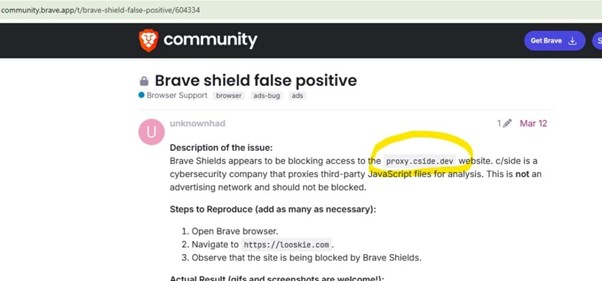
Because c/side runs as a client-side script, it is subject to browser policies and extension behavior. This theoretical risk became a documented reality when Brave blocked c/side’s script due to incorrect detection as a tracker. C/side’s CEO publicly appealed to Brave developers to reconsider the block, and subsequent references to the incident became difficult to locate publicly.
The lesson is not that Brave made an error. The lesson is that a security product whose protection disappears the moment a browser policy changes is not a reliable security product. Reflectiz’s remote monitoring architecture is unaffected by client-side browser policies entirely.
C/side is blind to cross-origin iframes
The Same-Origin Policy is a fundamental browser security mechanism: scripts running on the main page cannot inspect the contents of cross-origin iframes. This is not a c/side configuration issue — it is a browser-enforced constraint that applies to all in-browser scripts. It means c/side is structurally blind to attacks occurring inside payment iframes, which is one of the most common vectors for Magecart and supply chain attacks.
C/side has acknowledged this limitation publicly, noting they use an external scanner to fill the gap. That scanner carries the same theoretical evasion vulnerabilities c/side attributes exclusively to Reflectiz’s architecture. The question this raises is straightforward: if full visibility requires falling back to remote scanning, the case for an always-on in-browser agent as the primary architecture becomes considerably weaker. Reflectiz chose remote monitoring as its primary architecture precisely because it provides visibility that in-browser scripts structurally cannot.
C/side transmits real user session data
C/side’s implementation transmits data from real user sessions to c/side servers, including full page URLs. When those URLs contain session identifiers, usernames, or query parameters that constitute PII — routine in eCommerce and authenticated web applications — that data is transmitted to a third-party vendor’s infrastructure. In the context of GDPR and CCPA, this creates a compliance liability that c/side’s marketing materials do not prominently address.
This is worth examining carefully. A proxy solution that sits in the path of script delivery has, by architecture, access to the traffic flowing through it. Buyers should ask their vendor directly: what data transits your infrastructure, how is it handled, and what are your data residency commitments? These are the same questions you would ask any vendor operating as a data processor under GDPR Article 28.
Reflectiz transmits no user data. The platform analyzes your web environment remotely. No real user sessions are touched.
The evasion calculus c/side gets backwards
C/side’s central evasion argument is this: because Reflectiz monitors remotely, a sufficiently motivated attacker can detect it and serve clean content to the scanner while delivering the malicious payload to real users. It is worth taking seriously — and then examining what it actually requires in practice.
Start with the embedded side of the equation. Collecting and analyzing every user session in real time creates genuine performance overhead, privacy exposure, cost, and operational complexity. In practice, c/side — like every in-browser monitoring solution — makes choices about which sessions to inspect and when. The claim of universal, continuous, real-user visibility is more positioning than operational reality. Both architectures sample. The question is which sampling approach is harder to defeat.
Then consider the business logic of the attacks c/side is describing. If an attacker wants to steal payment data, PII, or credentials at scale — which is the objective behind every significant Magecart campaign on record — restricting the attack by geography, user agent, time window, or session condition directly reduces the value they extract. The more conditions they add, the fewer victims they reach. This is why the largest and most damaging client-side attacks we have observed do not rely on heavy geo-targeting as a core evasion method. Attackers want reach. Conditions cost them revenue.
The deeper asymmetry runs in the opposite direction from what c/side argues. When c/side’s script is embedded on the page, the attacker can see it. Malicious code already executing in that browser environment can detect the presence of a monitoring script, fingerprint its behavior, and suppress or redirect activity accordingly. C/side is visible to the attacker by design — it must be on the page to function, and being on the page means being observable.
Reflectiz has no presence on the page. There is nothing for a malicious script to detect, fingerprint, or avoid. To evade Reflectiz, an attacker must identify an unknown external observer — operating from an unknown location, at an unknown time, with unknown behavioral patterns — and construct evasion logic that defeats all of those parameters simultaneously, without knowing any of them. That is not a realistic optimization for a threat actor trying to maximize scale. It is a theoretical edge case that c/side’s comparison presents as the default scenario.
The asymmetry is not that remote monitoring makes attacks harder for Reflectiz to see. It is that Reflectiz makes attacks harder for the attacker to hide.
The blocking argument c/side made — and why it no longer holds
C/side’s central technical claim was this: without persistent code on your site, you cannot block a malicious script. It is no longer accurate.
Reflectiz offers on-demand script blocking through the Idle Blocking Script — a CSP-based response mechanism controlled entirely from the Reflectiz UI. When a confirmed threat is detected, the security team initiates a block from the UI. The script activates, adds a Content Security Policy meta header that excludes the malicious domain, and prevents it from executing. When the threat is resolved, one click reverts the block and the script returns to idle. No persistent code remains running between incidents.
It is also worth noting the broader context of how enterprise security teams actually use blocking. Based on our experience across hundreds of enterprise deployments, blocking in a production web environment is used as a deliberate, targeted response to a confirmed threat — not as a continuous default state. Security teams do not want always-on blocking infrastructure running across every page load as a permanent condition of deployment. They want accurate detection, fast alerting, and a reliable way to act when something is confirmed. That is exactly what Reflectiz’s architecture delivers: continuous monitoring as the primary posture, with surgical on-demand blocking available when needed.
The architectural comparison is direct. C/side’s blocking runs continuously — always in the delivery path, adding persistent overhead to every page load regardless of whether any threat is present. Reflectiz’s blocking is idle by default. Zero code executing. Zero performance impact. Zero compliance risk. Zero compatibility exposure. It activates only after a confirmed threat and a deliberate human decision to act. For the vast majority of real-world threat scenarios, CSP-based domain blocking is equally effective at preventing malicious script execution — and it cannot be defeated by c/side’s own identified Shadow DOM vulnerability, because CSP enforcement operates at the browser’s resource-loading layer before script execution begins.
The claims c/side made that are simply inaccurate
“Reflectiz makes snapshots for a compliance checkbox.”
False. Reflectiz performs continuous behavioral monitoring against established baselines with real-time deviation alerts. The platform inventories every third-party component, tracks behavioral changes, and triggers alerts on deviations — new scripts, changed payload destinations, unauthorized data flows, consent violations. Customers including Castore, Village Roadshow, Broadway Gaming Group, and lastminute.com run Reflectiz as always-on web supply chain monitoring infrastructure.
“Reflectiz onboarding is so complex they must do it for you.”
This claim does not survive contact with the customer record. Deepak K. Ramanujam, Head of Security at Apexx Global, described it this way: “I was shocked. From handing over the URLs to seeing a fully active dashboard was less than 24 hours. It was the most frictionless implementation I’ve ever experienced.” Read the full story: reflectiz.com/blog/apexx-pci-dss-success/
“I was shocked… From handing over the URLs to seeing a fully active dashboard was less than 24 hours. It was the most frictionless implementation I’ve ever experienced.” – — Deepak K. Ramanujam, Head of Security / Apexx Global
White-glove onboarding is a premium service option available to enterprise customers who want it — not evidence of product complexity. A remote platform that requires no code changes, no script tags, and no changes to production infrastructure is by definition simpler to deploy than a proxy solution that routes your live traffic through a third-party vendor’s servers. Notably, c/side’s own scan mode — offered to customers who cannot deploy their script — requires the same assisted configuration they attribute exclusively to Reflectiz.
“Reflectiz sees what attackers allow them to see.”
Reflectiz’s proprietary AI browser operates from diverse geographic locations, multiple user agents, and varied network conditions. The platform detects deviations from behavioral baselines — meaning that even if an attacker serves a clean payload during one monitoring cycle, any subsequent change to script behavior, network destination, or data collection triggers an alert. The attack surface is not a single scan window.
More pointedly: c/side’s in-browser monitoring code is far more readily identifiable than Reflectiz’s remote browser. A malicious script can detect c/side’s presence in the JavaScript environment and suppress malicious behavior accordingly. Reflectiz operates outside the browser environment entirely — there is nothing in the page for an attacker’s script to find. Even granting the theoretical scenario where an attacker serves different content to a monitoring system, that is a more defensible position than one where the attacker can read the full defense logic directly from the page.
“No publicly available QSA approval or certification listed.”
Multiple QSAs have reviewed and approved Reflectiz deployments for customers achieving PCI DSS 4.0.1 compliance under requirements 6.4.3 and 11.6.1 — across dozens of active engagements. Reflectiz’s working relationship with Integrity360, a firm with a dedicated PCI DSS practice and Gartner recognition, provides independent expert validation that goes beyond a co-authored vendor white paper. The absence of a co-branded marketing document is not evidence of absent validation. You can read how Reflectiz helped Village Roadshow pass their PCI audit here: reflectiz.com/blog/village-roadshow-simplifies-pci-dss-compliance/
Having said that, in the coming weeks a joint whitepaper by Integrity360 and Reflectiz about PCI DSS solution assessment will be widely available.
Reflectiz lacks SOC 2 Type II (implied in comparison table)
An unverified assertion presented without citation or evidence. But the more instructive question is why each vendor’s SOC 2 status matters differently. SOC 2 Type II is a compliance framework designed to demonstrate that a vendor responsibly manages the client data flowing through its systems. C/side’s architecture transmits real user session data, including full page URLs, to c/side servers. A vendor handling that data has a clear obligation to demonstrate SOC 2 compliance. Reflectiz’s remote monitoring architecture touches no user data — which is precisely why the compliance posture of each vendor looks different. Buyers should request security documentation from both vendors directly and evaluate it in the context of what data each vendor actually handles.
The “Ask Claude / Ask ChatGPT / Ask Perplexity” links
The AI links at the bottom of c/side’s page are pre-filled prompts that supply c/side’s own article as the source document, then ask language models to explain why c/side is better. This is a GEO manipulation technique — seeding LLMs with one-sided source material and presenting the output as independent AI confirmation. Any model reasoning from a biased primary source reflects that document’s framing. We flag it because security buyers increasingly use AI tools in vendor evaluation, and this technique is worth understanding.
What Reflectiz does that c/side structurally cannot
Monitor cross-origin iframes. Reflectiz operates via a remote browser outside the Same-Origin Policy constraint. It sees everything a user sees — including the contents of cross-origin iframes where payment skimmers most commonly operate. C/side cannot cross this boundary by design. Their own team has acknowledged it publicly.
Map fourth-party dependencies. Reflectiz tracks not just the scripts on your page but where those scripts call out to — their own dependencies, CDNs, and data partners. Most client-side security tools map only the scripts directly present on your page. Reflectiz maps the full downstream chain, surfacing hidden data flows to undisclosed third parties that create GDPR and PCI exposure invisible to first-hop-only inventory tools.
Transmit zero user data. Reflectiz monitors your web environment remotely. No real user sessions are touched. No URLs, session parameters, or behavioral data are sent to Reflectiz servers. C/side’s in-browser implementation transmits real session data including full page URLs.
Deliver privacy governance alongside security. Reflectiz maps PII flows across the web supply chain, supporting GDPR Article 28 processor obligations, CCPA data mapping, and cookie consent audit trails. C/side’s architecture is security-focused and does not offer comparable privacy governance.
Block without persistent overhead. The Idle Blocking Script is inactive by default. Zero code executing, zero data transmitted, zero compliance risk between incidents. It activates only after a confirmed threat and a deliberate decision to act, then returns to idle when the threat is resolved.
Operate outside the attacker’s reach. Because Reflectiz runs remotely, attackers cannot fingerprint, detect, or manipulate the monitoring. C/side runs inside the JavaScript environment where any script on the page can observe the defense logic — and where freely available deobfuscation tooling can recover that logic in seconds.
Where c/side genuinely has an edge
Proxy-layer interception. C/side’s gatekeeper mode intercepts third-party scripts before they reach the user’s browser rather than enforcing blocking at the browser level via CSP after the request is made. For the narrow set of threat scenarios where preventing delivery rather than preventing execution is the specific requirement, this is worth evaluating. For most real-world attack scenarios, CSP-based blocking at the execution layer is equally effective.
Reflectiz vs. c/side: Side-by-Side Capability Comparison
| Capability | Reflectiz | c/side |
| Zero code changes required | Yes, core architecture. | No, script tag required. |
| Detectable by malicious scripts | No, operates outside the browser. | Yes, in-browser presence can be fingerprinted/bypassed. |
| Cross-origin iframe visibility | Yes, full visibility via remote browser. | No, blocked by Same-Origin Policy. |
| 4th-party dependency mapping | Yes, full downstream call mapping. | Partial, script-level only. |
| Real user session data sent | None. | Yes, including full page URLs. |
| Privacy/PII data flow mapping | Yes, GDPR, CCPA, PCI governance. | Limited. |
| Script blocking | Yes, on-demand CSP-based (idle by default). | Yes, always-on gatekeeper proxy mode. |
| Blocking performance impact | Zero in idle state. | Continuous overhead on every page load. |
| Vulnerable to Shadow DOM bypass | No. | Yes, confirmed via technical analysis. |
| Keylogging protection | Complete. | Incomplete (obsolete method used). |
| Browser policy dependency | None. | Yes, browser/extension blocks remove protection. |
| PCI DSS 4.0.1 | Yes, dedicated module with audit reports. | Yes, co-authored white paper. |
| Third-party expert validation | Active relationship with Integrity360. | Co-authored white paper with commercial QSA. |
| Supply chain inventory | Yes, 1st, 3rd, and 4th-party. | Partial, script-level. |
| G2 rating (April 2026) | 4.7/5 (29 verified reviews). | 4.8/5 (11 reviews). |
| Named enterprise customers | Castore, Village Roadshow, lastminute.com, LION. | Limited public references. |
| Public pricing | Enterprise, contact for pricing. | From $999/year. |
Closing statement:
The technical record is clear. Reflectiz monitors your full web supply chain — including cross-origin iframes and fourth-party dependencies that in-browser scripts cannot see. It blocks malicious scripts on demand without persistent code. It transmits no user data. Its monitoring operates outside the browser environment where attackers have no sight line into the defense and where no deobfuscation tool can recover the defense logic in seconds. It works with Integrity360, one of Europe’s most respected independent cybersecurity firms, and carries 29 verified G2 reviews from named enterprise practitioners who deployed it in production.
Cside builds inside the glass house. Reflectiz monitors from outside it.
Read both pages. Verify the data independently. The evidence speaks for itself.

The Reflectiz Proactive Approach
Go beyond client-side security and vulnerability patching by taking a proactive approach to combat sophisticated web threats, gain deeper visibility, and mitigate security and privacy risks before they strike.


Reflectiz Provides Full-Suite Coverage of Web Threats



Here is what our clients had to say about us








FAQs
Can attackers evade Reflectiz’s remote monitoring by serving clean content to the scanner?
In theory, yes — and it is worth being direct about that. No monitoring architecture is perfect, and a sufficiently motivated attacker can attempt to serve different content to a known scanner. But this argument applies with equal force to embedded solutions. In-browser monitoring tools cannot analyze every user session in real time without creating performance, privacy, and cost problems — so they sample. Both architectures have coverage gaps. The question is which approach is harder to defeat in practice.
Two factors make Reflectiz’s position stronger than c/side’s framing suggests. First, the business logic of most client-side attacks runs against heavy evasion. Attackers targeting payment data or credentials want scale. Every geo-fence, time window, or user-agent condition they add reduces the number of victims they reach. The largest Magecart-style campaigns on record did not rely primarily on geo-targeting to evade detection — they relied on scale and speed. Conditions cost attackers revenue.
Second, and more fundamentally, Reflectiz is not visible to the attacker. There is no script on the page to fingerprint, no monitoring presence to detect, no behavioral signature to recognize and suppress. To evade Reflectiz, an attacker must construct evasion logic against an unknown observer operating from unknown locations at unknown times with unknown behavioral patterns — without any signal confirming whether the evasion is working.
C/side’s script, by contrast, is on the page. Malicious code already executing in the browser can observe it, fingerprint it, and suppress behavior in its presence. C/side’s own technical team has acknowledged this theoretical exposure.
The evasion concern c/side raises is real but asymmetric. Remote monitoring is harder for an attacker to detect and harder to deliberately evade. Embedded monitoring is harder for a passive attacker to avoid — but easier for a motivated one to identify and work around.
Can c/side monitor cross-origin iframes?
No. The Same-Origin Policy prevents any in-browser script from inspecting the contents of cross-origin iframes. C/side uses an external scanner to compensate — which carries the same theoretical evasion limitations c/side attributes exclusively to Reflectiz. Reflectiz monitors cross-origin iframes fully via its remote browser, without SOP constraints.
Can c/side’s in-browser script be detected and bypassed by attackers?
Yes. Because c/side’s monitoring code runs inside the browser alongside the scripts it monitors, it is fully readable by any script on the page. C/side obfuscates their production script, but obfuscation is not protection — automated deobfuscation tools recover human-readable source code in seconds. Once the defense logic is visible, writing a targeted bypass is straightforward. Our technical analysis identified specific vulnerabilities this exposes, including a Shadow DOM bypass and incomplete keylogging protection covering only an obsolete IE-era event method. Reflectiz operates outside the browser environment. There is nothing in the page for an attacker’s script to detect, extract, or manipulate.
Can Reflectiz detect geo-targeted, time-windowed, or conditional attacks?
All monitoring architectures face evasion challenges. Reflectiz’s behavioral baseline deviation detection means that even if an attacker serves a clean payload during one monitoring cycle, any subsequent change to script behavior, network calls, or data collection triggers an alert. Additionally, Reflectiz’s remote browser cannot be fingerprinted by scripts on the page. C/side’s in-browser agent can be — a malicious script can detect its presence and suppress malicious behavior accordingly.
Does c/side transmit real user data?
C/side’s in-browser implementation transmits data from real user sessions to c/side servers, including full page URLs. When those URLs contain session parameters or identifiers constituting PII — common in eCommerce and authenticated applications — that data is transmitted to a third-party server. Buyers should ask their vendor directly: what data transits your infrastructure, how is it handled, and what are your data residency commitments? Reflectiz transmits no user data at any stage.
Does Reflectiz support script blocking?
Yes. Reflectiz offers on-demand script blocking through its Idle Blocking Script — a CSP-based mechanism controlled from the Reflectiz UI requiring no developer involvement. The script is idle by default. No code runs on user browsers until a block request is explicitly triggered following confirmed threat detection. When the threat is resolved, one click returns the script to idle. No persistent code remains. No business or PII data is transmitted at any stage.
How does Reflectiz handle PCI DSS 4.0.1 requirements 6.4.3 and 11.6.1?
Reflectiz’s PCI module provides automated script inventory, behavioral change detection on payment pages, and audit-ready evidence reports without requiring code on the payment page. The Idle Blocking Script adds a response capability: when a malicious script is confirmed, it can be blocked via CSP from the Reflectiz UI without touching production code. QSAs have approved this approach across dozens of production audits. Read how Village Roadshow achieved compliance: reflectiz.com/blog/village-roadshow-simplifies-pci-dss-compliance/
Is Reflectiz a scanner or a real-time monitoring platform?
Reflectiz is a continuous behavioral monitoring platform. It monitors third-party components continuously, maintains behavioral baselines, and alerts on deviations. It is not a scheduled snapshot tool. The “scanner” framing used by competitors does not describe the architecture.
What is Reflectiz’s G2 standing vs c/side?
Reflectiz: 4.7/5 from 29 verified reviews, G2 High Performer. C/side: 4.8/5 from 11 reviews, G2 High Performer. Reflectiz has nearly three times the review volume — a more statistically meaningful signal of validated enterprise adoption at scale.
What is Reflectiz’s relationship with Integrity360?
Integrity360 is one of Europe’s leading independent cybersecurity services firms, Gartner-recognized, with dedicated PCI DSS, GDPR, and threat exposure management practices across 11 countries. Reflectiz and Integrity360 have an active working relationship that includes joint expert panels on web exposure security and participation at Security First London 2026. Integrity360’s CTO, Solutions Architect, and Regional Operations Director have all engaged with Reflectiz’s approach in a professional capacity. This is substantively different from a vendor co-authoring a white paper with a commercial QSA partner.
What is the difference between Reflectiz’s on-demand blocking and c/side’s always-on gatekeeper?
C/side’s gatekeeper runs continuously in the script delivery path on every page load, adding persistent overhead, compliance exposure, and compatibility risk regardless of whether any threat is present. Reflectiz’s Idle Blocking Script is inactive by default — no code executing, no data transmitted, no compliance risk until a threat is confirmed and a deliberate block is initiated. Both block malicious domains. The difference is whether blocking infrastructure runs at all times or only when needed. Based on our experience across hundreds of enterprise deployments, security teams use blocking as a targeted response to confirmed threats, not as a continuous default state.
Which companies use Reflectiz?
Published customer case studies include Castore, Village Roadshow, Broadway Gaming Group, lastminute.com, Apexx Global, Leeds United, and LION. Village Roadshow and Broadway Gaming Group have specifically credited Reflectiz with achieving PCI DSS 4.0.1 compliance. Castore deployed Reflectiz across 30+ online stores and discovered vulnerabilities their own vendors were unaware of. Apexx Global was fully operational within 24 hours of handing over URLs.
Why does the SOC 2 Type II comparison matter differently for each vendor?
SOC 2 Type II is a compliance framework designed to demonstrate that a vendor responsibly manages the client data flowing through its systems. C/side’s architecture transmits real user session data to c/side servers — a vendor in that position has a clear obligation to demonstrate SOC 2 compliance. Reflectiz’s remote monitoring architecture touches no user data, which is why the compliance posture of each vendor looks different. Buyers should request security documentation from both vendors directly and evaluate it in the context of what data each vendor actually handles.