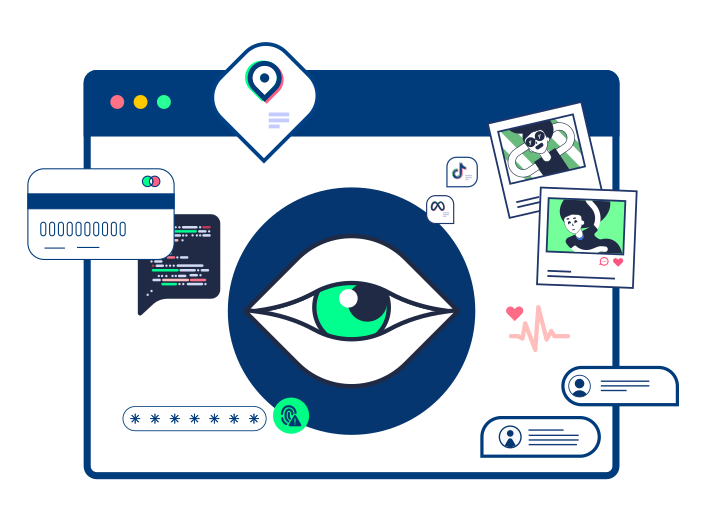
The AI Visibility Gap Is Real – And It Lives on Your Website


Not a single CISO has full visibility into how AI is operating across their organization. Not one. That’s the headline finding from Pentera’s AI Security & Exposure Benchmark 2026 – a survey of 300 U.S. CISOs and senior security executives – and it should give every web security team pause.
Because a significant share of that invisible AI isn’t hiding deep in cloud infrastructure or internal networks. It’s running on your website, right now, in your customers’ browsers.
AI Is Everywhere. Visibility Is Not.
66% of CISOs report limited visibility into AI usage across their environments, acknowledging shadow AI as a known and ongoing issue. The remaining 33% consider themselves relatively well-informed. But still expect unauthorized or unmanaged AI activity within their environments. Zero reported full visibility with no shadow AI present.
This isn’t a governance edge case. It’s the baseline condition of enterprise AI adoption in 2026.
Shadow AI is usually discussed in terms of employees using unsanctioned tools like ChatGPT or niche AI platforms. But the less-discussed dimension is what happens when AI capabilities are quietly introduced through software already embedded in your environment. Third-party pixels, analytics scripts, session-replay tools, recommendation engines, and ad-tech integrations are all examples of code executing on your web properties that can carry AI-powered data collection, behavioral profiling, or unauthorized data processing — without ever triggering an internal procurement review.
Reflectiz continuously monitors exactly this layer. The Reflectiz platform maps every script and third-party integration running across your web properties, detecting behavioral changes and unexpected data flows in real time — the kind of activity that never appears in a network log or SIEM alert.
Legacy Controls Are Covering AI Risk. Badly.
75% of CISOs rely on traditional endpoint, cloud, application, or API security tools (originally designed for other attack surfaces) to protect their AI ecosystems. Only 11% have security tools built specifically for AI.
This pattern is familiar. It mirrors what happened when organizations tried to stretch legacy perimeter defenses over cloud environments, or endpoint tools over mobile. The attack surface moved; the controls didn’t.
Client-side web environments are a textbook example of this mismatch. WAFs, SIEMs, and DLP solutions monitor what crosses your network perimeter. They have no visibility into what happens inside a browser session: which scripts execute, what data they access, where that data goes, and whether any of that behavior changed since yesterday. When a third-party tool begins routing sensitive session data to an unexpected domain, whether due to supply chain compromise or a deliberate vendor-side change, it happens entirely within the client-side execution context. Most of the security stack never sees it.
Reflectiz has documented exactly this type of incident in real enterprise environments, including cases involving payment card data with direct PCI DSS implications.
Web-Facing Assets Are the #1 Breach Entry Point
When the report asked CISOs which parts of their infrastructure were compromised in successful attacks, web-facing assets ranked first, cited in 62% of breach incidents, ahead of endpoints (60%), identity and access controls (53%), and cloud infrastructure (46%).
The report also shows that attackers don’t stop at the entry point. Once a foothold is established through a web asset, movement continues toward identity systems, APIs, cloud infrastructure, and in 18% of incidents, AI ecosystems directly.
Protecting web-facing assets isn’t just about preventing initial access. It’s about closing the gateway through which broader, deeper compromise becomes possible.
The Barrier Is Visibility and Expertise, Not Budget
The report identifies the top two barriers to securing AI as lack of internal expertise (50%) and limited visibility into AI usage (48%). Only 17% cite budget constraints as their primary challenge. The problem isn’t resources; it’s the foundational work of understanding, governing, and monitoring AI systems already embedded across the enterprise.
This maps directly to what security teams face on the client side. Most organizations lack a clear inventory of every third-party script running on their websites, let alone visibility into how those scripts behave session-to-session. Reflectiz delivers that inventory automatically and continuously, without requiring code changes or agent deployment, thus closing the visibility gap without adding to the operational load of an already stretched team.
Continuous Validation Is What Builds Confidence
The report frames Continuous Threat Exposure Management (CTEM) as the operating model best suited to the AI era, moving from point-in-time assessments to ongoing validation across the full attack surface. And the data backs it up: CISOs at organizations that test quarterly report higher AI security confidence (80%) than those who test annually (71%). Confidence comes from continuous validation, not assumptions.
Reflectiz operates on the same principle. Web exposure isn’t a status you establish once, it’s a condition that requires continuous monitoring, because third-party scripts change, vendors update their code, and supply chains shift without warning. For organizations working toward PCI DSS 4.0.1 compliance, which now mandates controls for scripts on payment pages, that continuous monitoring isn’t optional hygiene. It’s a regulatory requirement.
The Pentera report makes clear that the security challenges of the AI era are not fundamentally new. They are existing problems: incomplete asset visibility, legacy controls stretched beyond their design, fragmented ownership, inconsistent validation – amplified by the speed and scale of AI adoption. Solving them requires looking in the right places. On the web, that means the client side.
See what’s running on your website right now. [30 day free trial →]
FAQs
How can organizations achieve better visibility into client-side AI activity compared to manual script audits?
Automated client-side monitoring platforms provide continuous real-time detection of script behaviors and data flows that manual audits miss. Unlike periodic reviews, these tools map every third-party integration, detect behavioral changes instantly, and identify AI-powered data processing as it occurs across all web properties.
How does shadow AI affect client-side web security?
Shadow AI operates through third-party scripts, analytics tools, and ad-tech integrations that execute AI-powered data collection in browsers without IT approval. These client-side AI capabilities can perform behavioral profiling and unauthorized data processing while remaining invisible to traditional network monitoring tools and SIEM systems.
How does the AI visibility gap impact compliance with GDPR and data privacy regulations?
Undetected AI processing in third-party scripts can violate GDPR consent requirements and data minimization principles. Organizations may unknowingly allow AI-powered behavioral profiling and data collection that occurs without proper user consent or legal basis, creating significant compliance risks.
What is the AI visibility gap in cybersecurity?
The AI visibility gap refers to organizations’ inability to detect and monitor AI-powered activities across their infrastructure. According to Pentera’s 2026 benchmark report, zero CISOs have full visibility into AI operations, with 66% reporting limited visibility and acknowledging shadow AI as an ongoing issue.
What types of third-party scripts can contain hidden AI capabilities?
Common third-party integrations that may contain AI include pixels, analytics scripts, session replay tools, recommendation engines, chatbots, and ad-tech platforms. These scripts can introduce AI-powered behavioral profiling, data collection, and processing capabilities without triggering internal procurement or security reviews.
When should CISOs start monitoring for AI activity in client-side environments?
CISOs should implement client-side AI monitoring immediately, as 100% of surveyed security executives expect unauthorized AI activity in their environments. The baseline condition of enterprise AI adoption in 2026 includes shadow AI, making proactive detection essential rather than reactive.
Who is responsible for detecting AI-powered third-party scripts on corporate websites?
Web security teams and CISOs share responsibility for client-side AI detection, as traditional IT and network security teams lack visibility into browser-level script execution. This requires specialized client-side monitoring tools that can track third-party integrations and their behavioral changes in real-time.
Why can’t traditional security tools detect AI activity on websites?
Legacy security tools like WAFs, SIEMs, and DLP solutions only monitor network perimeter traffic, not browser-level execution. They cannot see which scripts execute within client-side environments, what data they access, or how AI-powered third-party integrations process user information in real-time.
Subscribe to our newsletter
Stay updated with the latest news, articles, and insights from Reflectiz.
Related Articles




AI Has Changed The Web.
Are You Ready for What’s Next?
Third-party code shifts by the hour. Supply-chain compromises strike without warning. AI-driven web attacks now evolve faster than traditional security can ever keep up.
Reflectiz delivers the continuous, real-time visibility needed to expose the risks traditional tools miss entirely.
Zero code changes. Zero access to your data. Ultimate peace of mind.