10 Most Influential Men in Cybersecurity You Should Follow in 2026




In October 2005, a 19-year-old security researcher wrote 4 kilobytes of JavaScript and uploaded it to his MySpace profile.
Twenty hours later, over 1 million MySpace profiles were infected.
Samy Kamkar didn’t use malware. He didn’t trick people into clicking links. He just exploited how browsers handle third-party code. His worm spread by simply viewing an infected profile. No clicks. No downloads. Just JavaScript executing in the browser.
MySpace shut down to stop the spread. The Secret Service raided Samy’s home in 2006. But he’d already proved something the security industry was ignoring: client-side attacks work at a massive scale.
That was 2005. The techniques from his worm are still used by attackers today.
That’s the difference between security theater and security that works. Understanding how attacks actually happen. Not the marketing version. The technical reality.
The cybersecurity industry is crowded with noise. Vendor pitches. Conference buzzwords. Products that promise everything and deliver compliance checkboxes. In that noise, a handful of voices cut through because they focus on what actually matters: understanding how systems break, how attackers think, and what’s genuinely at risk.
We built this list around one question: whose insights make us better at security? Not whose follower count is highest. Not who posts most often. Who actually moves the conversation forward on vulnerabilities, exposure, and how organizations get compromised?
These 10 people shaped how the industry thinks about web security, supply chain risk, breach disclosure, and the gap between what security teams think they’re protecting and what’s actually exposed. Some discovered the vulnerabilities we’re racing to fix. Others reported the breaches that changed how we think about third-party risk. A few built the frameworks that proved reactive security doesn’t scale.
If you’re responsible for securing web applications, managing third-party relationships, or understanding your attack surface, you’re already learning from these people. Whether you realize it or not.
Following our International Women’s Day feature celebrating influential women in cybersecurity, we’re highlighting male voices who’ve shaped the conversation around web security, supply chain risk, and exposure management.
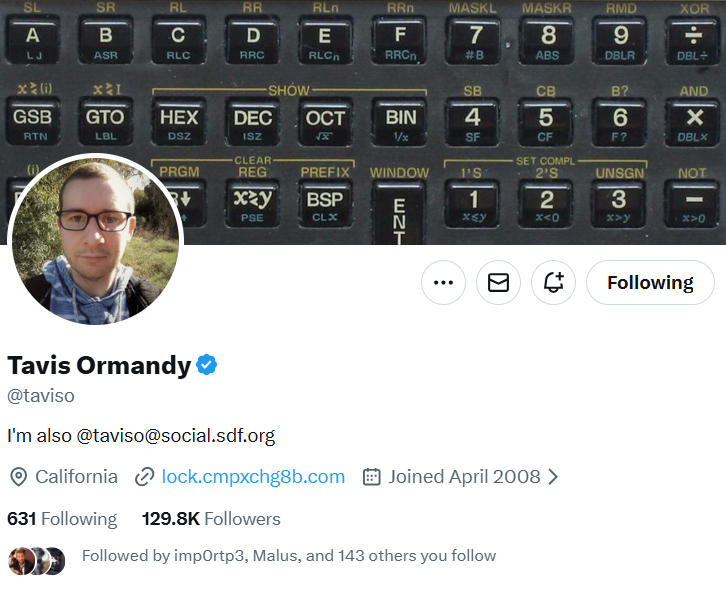
10. Tavis Ormandy (@taviso)
Platform: X, Website
Focus: Vulnerability research, browser security, Google Project Zero
Tavis Ormandy is a security researcher at Google Project Zero, where he hunts for the critical vulnerabilities that most security teams never see until they’re exploited. His research focuses on browsers, operating systems, and the security boundaries that protect users from malicious code.
He’s discovered critical vulnerabilities in Chrome, Firefox, Windows, and countless third-party libraries. His bug reports read like master classes in offensive security research. He doesn’t just find vulnerabilities, he documents exactly how they work and why they matter.
Why his voice matters:
Browser vulnerabilities enable client-side attacks. Every XSS exploit, every malicious script injection, every client-side attack relies on browser behavior that security researchers like Tavis discover and help fix. His work at Project Zero directly protects the attack surface that enterprises struggle to monitor. When Tavis publishes a vulnerability, it’s because he found something that could compromise millions of users.
What makes him influential:
Over 15 years of elite-level vulnerability research. His discoveries forced browser vendors, operating system developers, and security teams to fix critical flaws before attackers weaponized them. His technical depth and willingness to publish detailed analyses help security professionals understand not just what’s vulnerable, but why.
9. John Hammond (@_JohnHammond)
Platform: YouTube, X, Twitch, Website
Focus: Malware analysis, CTF challenges, security education through video content
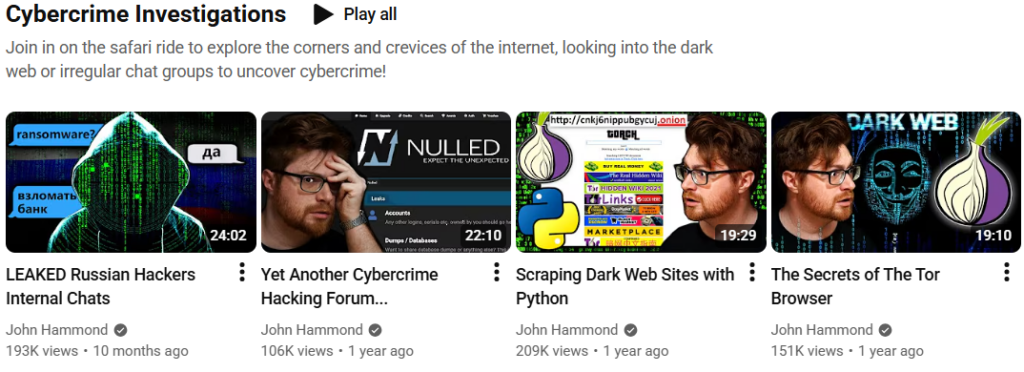
John Hammond represents the next generation of security education. His YouTube channel breaks down malware analysis, CTF (Capture The Flag) challenges, and security research with clear, accessible explanations that make complex topics understandable.
He live-streams security research, creates detailed walkthroughs of vulnerabilities, and builds a community around learning offensive security techniques. His content reaches hundreds of thousands of aspiring security professionals who learn by watching him analyze real malware, solve security challenges, and explain exploitation techniques.
Why his voice matters:
John makes security research accessible. His video breakdowns of web vulnerabilities, malware analysis, and exploitation techniques help developers and security teams understand how attacks actually work. His focus on education through demonstration shows that client-side attacks, script injection, and web-based malware delivery aren’t abstract threats, they’re practical techniques with real-world impact.
What makes him influential:
Over 500K YouTube subscribers and consistent content creation that reaches security professionals who learn visually. His approach to education through demonstration builds the next generation of security researchers who understand offensive techniques well enough to build better defenses.
8. Clint Gibler (@clintgibler)
Platform: X, tl;drsec.com
Focus: AppSec, DevSecOps, security tooling, supply chain security
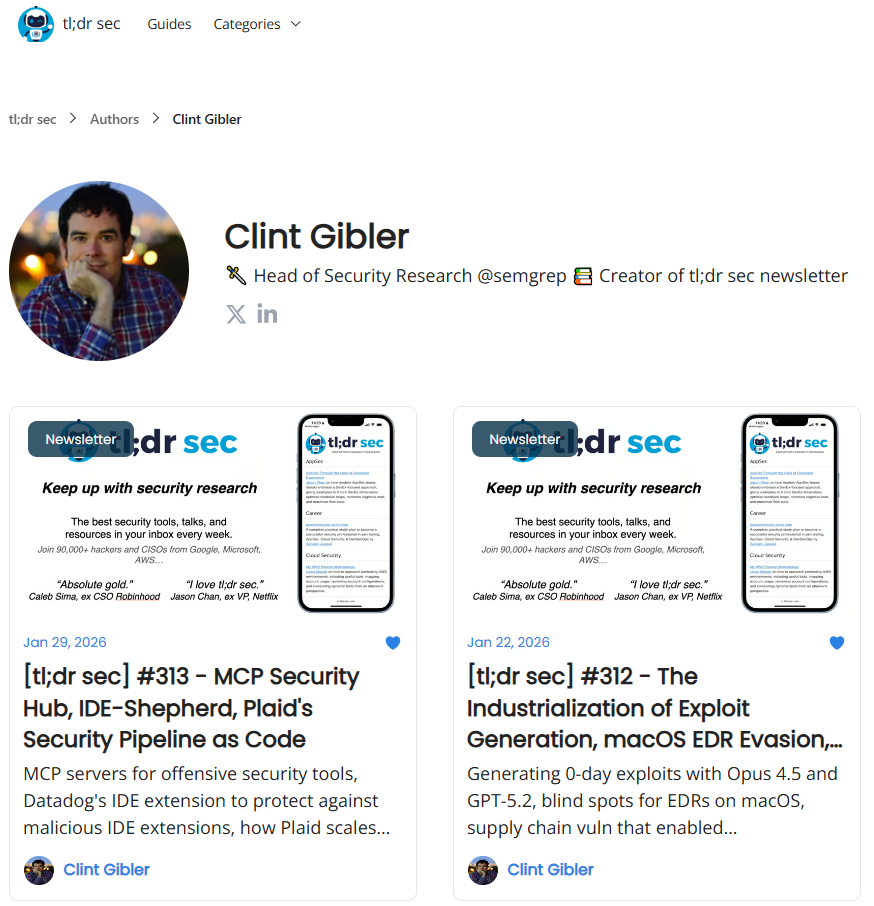
Clint Gibler makes application security practical for developers. His tl;dr sec newsletter curates the best AppSec research, security tools, and defensive techniques every week, focusing on approaches that actually fit into development workflows without destroying velocity.
His work on third-party dependency management, supply chain security in CI/CD pipelines, and developer-friendly security tools helps teams build security in rather than bolt it on after deployment.
Why his voice matters:
Third-party risk doesn’t just exist in vendor relationships. It exists in npm packages, container images, cloud service dependencies, and every line of code you didn’t write. Clint’s focus on supply chain security in development helps teams understand that securing software means understanding your entire dependency tree, both at build time and runtime.
What makes him influential:
Practical, actionable security advice that developers actually implement. His newsletter doesn’t just highlight problems. It provides specific tools, techniques, and approaches that make application security measurable and improvable.
7. Daniel Miessler (@DanielMiessler)
Platform: X, LinkedIn, Unsupervised Learning newsletter
Focus: Security architecture, CTEM frameworks, AI security, emerging threats
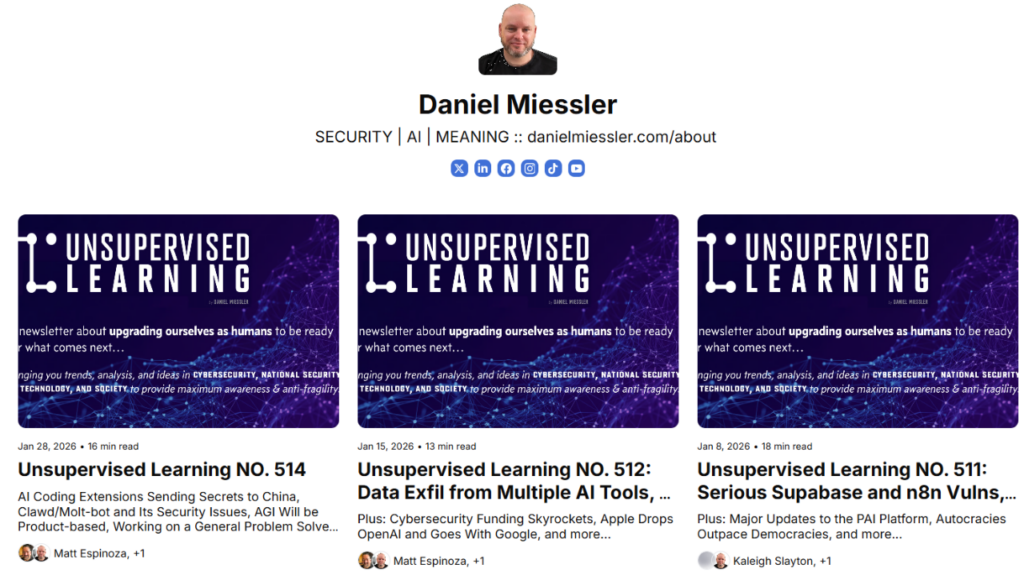
Daniel Miessler thinks in frameworks. His Unsupervised Learning newsletter (running since 2008) breaks down complex security topics into structured approaches, and his work on Continuous Threat Exposure Management (CTEM) is changing how security teams prioritize resources.
He doesn’t just identify threats. He builds systematic approaches to managing them. His frameworks on attack surface management, security program development, and exposure reduction help CISOs translate security concepts into operational programs.
Why his voice matters:
Daniel articulates why exposure management beats threat detection. The old approach was reactive: detect threats, respond to incidents, chase attackers. The new approach is proactive: map your attack surface, reduce exposure, eliminate vulnerabilities before they’re exploited. His thinking on CTEM, security architecture, and program development shapes how security leaders allocate resources and measure effectiveness.
What makes him influential:
Over 15 years of consistent security education through his newsletter, combined with practical experience building security programs. His ability to create frameworks from complex topics helps security teams move from theory to implementation.
6. Samy Kamkar (@samykamkar)
Platform: X, YouTube
Focus: Security research, exploit development, hardware hacking
In 2005, Samy Kamkar released a JavaScript worm that infected over 1 million MySpace profiles in 20 hours. The “Samy worm” used pure client-side code to self-replicate, exploiting browser vulnerabilities and web application logic flaws. It proved that client-side attacks could spread at massive scale without malware, without phishing, just by leveraging how browsers execute third-party code.
The worm’s impact was immediate. MySpace temporarily shut down to contain the spread. In 2006, the Secret Service raided Samy’s home, and he eventually pled guilty to a felony charge. He received three years of probation, 720 hours of community service, and was initially restricted from using computers except for work.
Since completing his probation, Samy has become a respected security researcher, speaking at major conferences and contributing to privacy and security tools used worldwide. His MySpace worm forced the industry to take client-side security seriously. He’s since demonstrated vulnerabilities in browser extensions, wireless protocols, automotive systems, and IoT devices. His research isn’t theoretical. It’s working proof-of-concept code that shows exactly how attacks execute.
Why his voice matters:
Samy proved that client-side exploits work at scale. The techniques from his 2005 worm are still used by attackers today. His ongoing research demonstrates vulnerabilities in systems most people assume are secure, and his detailed technical writeups help security teams understand not just that attacks are possible, but exactly how they work.
What makes him influential:
Nearly 20 years of security research that combines technical depth with practical demonstration. His exploits don’t just exist in lab environments. They work in production systems, which forces vendors and security teams to take threats seriously.
5. Orange Tsai (@orange_8361)
Platform: X, Blog
Focus: Web vulnerability research, bug bounty, enterprise application security
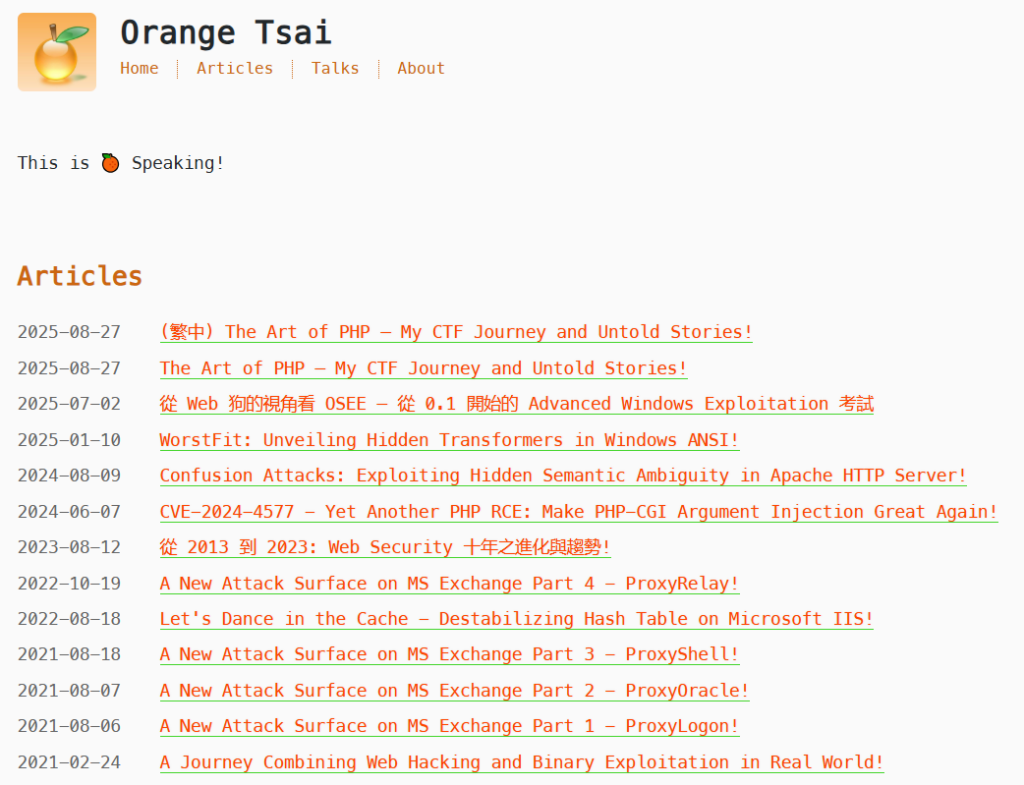
Orange Tsai is a principal security researcher at DEVCORE who discovers the critical web vulnerabilities that compromise enterprise applications at scale. In early 2021, he discovered a series of critical Microsoft Exchange Server vulnerabilities. Microsoft patched them in March 2021, but within days of public disclosure, nation-state actors were exploiting them. Within weeks, ransomware groups had compromised thousands of organizations.
The vulnerabilities, known as ProxyLogon and ProxyShell, were so severe that the White House issued emergency warnings. Orange didn’t just find bugs. He discovered chains of vulnerabilities that let attackers bypass authentication, execute code remotely, and compromise entire email infrastructures. Tens of thousands of organizations worldwide were exposed.
His research focuses on finding novel attack vectors in widely-deployed enterprise applications. His bug bounty success and vulnerability discoveries have earned him top rankings at Pwn2Own and recognition as one of the most impactful web security researchers globally.
Why his voice matters:
Orange discovers the web application vulnerabilities that actually get exploited at scale. ProxyLogon and ProxyShell weren’t theoretical risks, they became active attack vectors used in real breaches. His research shows how attackers chain seemingly minor vulnerabilities into critical exploits, and why web application security requires understanding how components interact, not just scanning for known patterns.
What makes him influential:
Consistent discovery of critical vulnerabilities in enterprise web applications. His research presentations at Black Hat and DEFCON provide technical depth that helps security teams understand modern web attack surfaces. When Orange publishes research, security teams pay attention because his discoveries become active threats.
4. Kevin Beaumont (@GossiTheDog)
Platform: Mastodon, X
Focus: Vulnerability research, threat intelligence, security product analysis
Kevin Beaumont built his reputation by documenting what actually works in security versus what’s marketing. His vulnerability research is technically detailed. His breach analysis is direct and evidence-based. His criticism of ineffective security products is brutally honest.
He’s deployed honeypots to track attacker behavior, reverse-engineered malware to understand exploitation techniques, and published vulnerability research on everything from Microsoft Exchange to enterprise VPN gateways. His commentary consistently cuts through vendor hype to focus on what’s actually exploitable.
Why his voice matters:
Kevin holds the industry accountable. When vendors oversell capabilities, he documents it. When vulnerabilities are actively exploited, he provides technical details security teams need to defend. When security theater replaces actual protection, he calls it out. His work keeps conversations focused on real risk rather than theoretical threats.
What makes him influential:
Technical credibility without corporate constraints. He’s not selling products or building a consulting practice. He’s documenting vulnerabilities, analyzing breaches, and sharing defensive strategies because that’s what improves security.
3. Jeremiah Grossman (@jeremiahg)
Platform: X, LinkedIn
Focus: Web application security, browser security, attack surface management
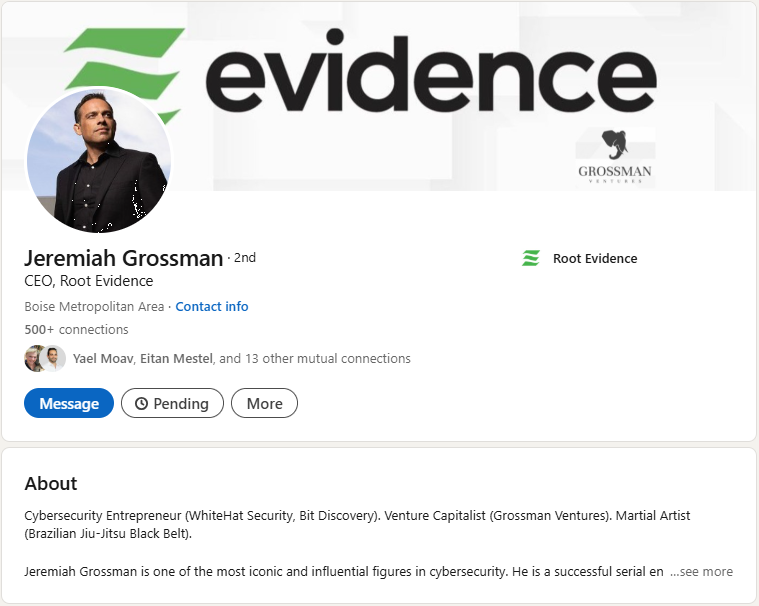
Jeremiah Grossman founded WhiteHat Security in 2001 and spent two decades proving that web applications aren’t just vulnerable, they’re the primary attack surface for most organizations. His research on DOM-based XSS, clickjacking, and browser vulnerabilities fundamentally shaped modern web security.
He was one of the first researchers to document how third-party JavaScript could be weaponized, how browser features created security risks, and why traditional perimeter security couldn’t protect web applications. His work laid the technical foundation for understanding client-side attack surfaces before the term existed.
Why his voice matters:
Jeremiah documented the vulnerabilities that define modern web security. Cross-site scripting. Clickjacking. CSRF. Browser exploitation. His research proved that web applications are fundamentally different from traditional software, and securing them requires different tools and approaches. His insights on attack surface management and exposure reduction continue to challenge security teams who focus on threat detection rather than vulnerability elimination.
What makes him influential:
Over 20 years of consistent research that shaped how the industry understands web security. He identified vulnerabilities that became CVEs, developed exploitation techniques that became standard attack patterns, and advocated for defensive strategies that are now industry best practices.
2. Brian Krebs (@briankrebs)
Platform: X, LinkedIn, KrebsOnSecurity blog
Focus: Investigative cybercrime journalism, supply chain attacks, underground economies
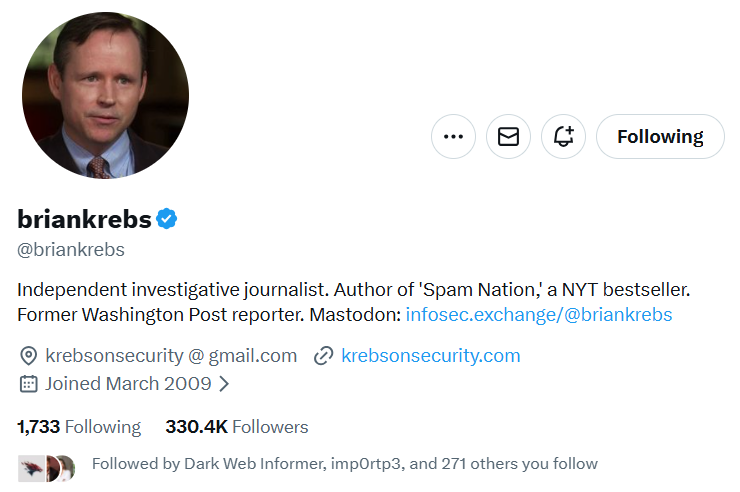
Brian Krebs doesn’t just report breaches. He investigates them. For over 15 years, his independent journalism on KrebsOnSecurity has broken stories about Magecart attacks, vendor compromises, SIM swapping operations, and cybercrime underground forums that fundamentally changed how organizations assess risk.
His 2014 book “Spam Nation” exposed the Russian cybercrime ecosystem. His reporting on the Target breach revealed how HVAC vendor credentials led to payment card theft from 40 million customers. His coverage of Magecart attacks brought mainstream attention to client-side payment skimming before most security vendors acknowledged the threat.
Why his voice matters:
Brian connects individual incidents to systemic vulnerabilities. When he investigates a breach, he doesn’t just report what happened. He shows how attackers operate, what defenders missed, and what other organizations should worry about. His work on supply chain compromises, vendor security, and third-party risk forced enterprises to stop treating partner access as a secondary concern.
What makes him influential:
Two decades of consistent investigative journalism that prioritizes accuracy over speed. When Krebs publishes an investigation, CISOs pay attention because his research is thorough, his sources are credible, and his analysis changes threat models.
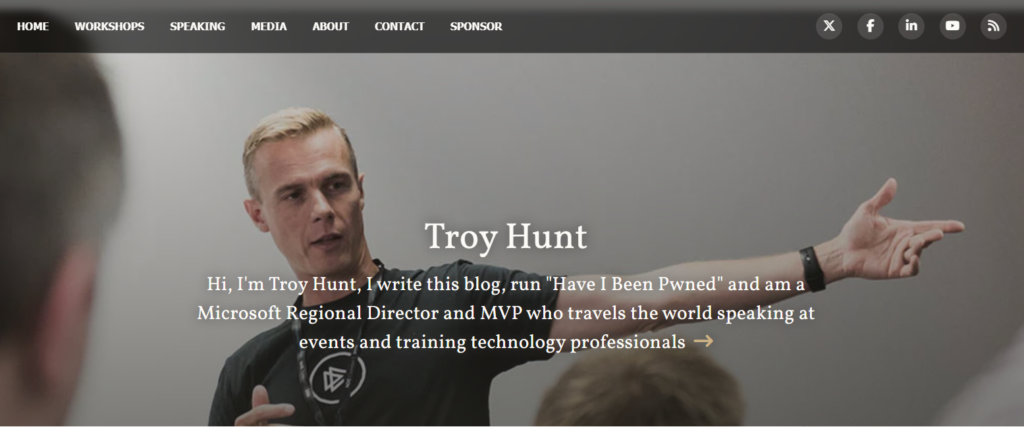
1. Troy Hunt (@troyhunt)
Platform: X, LinkedIn, Blog
Focus: Data breach transparency, web security education, password security
Troy Hunt made breach visibility accessible to everyone. In 2013, he launched HaveIBeenPwned after the Adobe breach exposed 153 million accounts. Most people had no way to know if their data was compromised. Troy built a free tool that’s now checked over 15 billion breached accounts and fundamentally changed how organizations approach breach disclosure.
His approach strips away security jargon. No fear tactics. No vendor pitches. Just clear information about what happened, who’s affected, and what to do next. He’s testified before government committees, advised Fortune 500 companies, and remained committed to keeping breach data accessible to everyone.
Why his voice matters:
Troy proved that visibility isn’t optional. You can’t fix breaches you don’t know about. You can’t protect users who don’t know they’re compromised. That principle applies across security: exposure management starts with knowing what’s actually exposed. His work on third-party data sharing, API security, and privacy-first architecture continues to challenge how enterprises think about protecting user data.
What makes him influential:
Over a decade of consistent, practical security education. His conference talks, blog posts, and weekly security updates have trained an entire generation of security professionals to think about breach disclosure, password security, and user privacy differently.
Why These Voices Changed Security
These people didn’t just build large followings. They changed how the industry thinks about fundamental problems.
They forced us to take breach disclosure seriously. They exposed supply chain attacks before they were a product category. They documented client-side vulnerabilities still being exploited today. They hold vendors accountable when security theater replaces real protection.
They discover the browser bugs that enable attacks. They prove client-side exploits scale. They build frameworks that translate concepts into programs. They make security education accessible to the next generation.
They’re influential because they focus on what matters: understanding how systems actually break, how attackers actually operate, and what organizations actually need to protect. No vendor pitches. No buzzwords. Just technical depth, investigative journalism, and practical security that works.
When these voices talk about supply chain security, third-party risk, web vulnerabilities, and exposure management, security leaders listen. Not because they have the largest platforms, but because they’ve been right about the threats that matter.
The age of chasing hackers is over. The real risk lives in your exposure.
Subscribe to our newsletter
Stay updated with the latest news, articles, and insights from Reflectiz.



Your Website looks great!
But what’s happening behind the scenes?
Discover your website blind spots and vulnerabilities before it’s too late!